The programme for the 115th annual meeeting of the American Anthropological Association (16-20 November) in Minneapolis is now available. I have compiled a list of sessions, papers and meetings that will be of interest to people working in Oceania. Unfortunately I don’t have access to the abstracts or list of venues (this content is restricted to those paying to attend the AAAs), but this is a good general guide to some of the interesting work being presented this year.
If I have missed anything please let me know so I can add it!
SOMAA will be launched in February 2017 at a one-day symposium at Victoria University of Wellington. Professor Marcia Inhorn (Yale University) will be the keynote speaker. The symposium will showcase current work in medical anthropology, with a particular focus on how work from/on the New Zealand context innovates, challenges and contributes to core theoretical debates in medical anthropology internationally. Questions addressed could include:
How does the political, legal, cultural and historical context of New Zealand society sharpen or refashion the issues medical anthropology can address and the critiques it can offer wider academic debates?
How does research from or on Aotearoa advance debates about ethics, medicine and illness, particularly in areas where medical anthropology has often critically intervened, such as in relation to practices of care, autonomy, responsibility, medicalization, inequality and the body?
How do New Zealand’s current neoliberal politics, its state model of healthcare, and its national pharmaceutical regime intersect…
I am pleased to welcome guest blogger Jess Thompson to anthropod. In this post Jess shares her experiences of being a parent and university student, adding to our conversation about carework at university.
I wouldn’t say I’m a typical young woman at the mere age of 22; I threw myself into the world of academia at 18 years old like most my age, but I’d already moved to and worked in London for five months after leaving high school. After 2 ½ years at Victoria University I got on a plane and didn’t look back, ventured to Samoa, and volunteered on a development assignment before returning to finish my final papers for my degree this year. En-route, things took a sharp turn with the arrival of my son (Moo) 8 ½ months ago. Three papers short on my Bachelors in Development and International Relations, suddenly I was faced with a situation I had not anticipated; do I work my life around my son, work my son around my life, or just throw it all away and become a full time mum?
Today, the result of finding a middle ground between the former two options exists. It’s not perfect, but it’s better than I could have hoped for. Moo and I are not a nuclear family; I am a co-parent with his dad, a system in place since he was born, and as circumstances arise and Moo gets older, our situation changes as needed. I study part-time, three generations of my family occupy the house I live in, and I’ve not only returned to my volunteer role at GirlGuiding New Zealand as a Ranger Leader (girls aged between 12 ½ and 17), but also taken on an additional role of being a Training Assistant, on the pathway to becoming a Trainer for other Leaders. I live my life as I choose, and integrate Moo into it as required if he is in my care.
From an academic point of view, things have been generally speaking, relatively straight forward. I make the most of the time Moo is with his dad as study time and work care arrangements around lectures and tutorials. But if there was ever a piece of advice read here: you have to be a little crazy and whole lot of adaptable to take an intense 5 week summer paper with a two month old. I would sit at my desk and be working on assignments or catching up on readings with Moo lying next to me playing, or almost begging him to go down for a sleep so I could get an hour’s peace to get part of an essay knocked off.
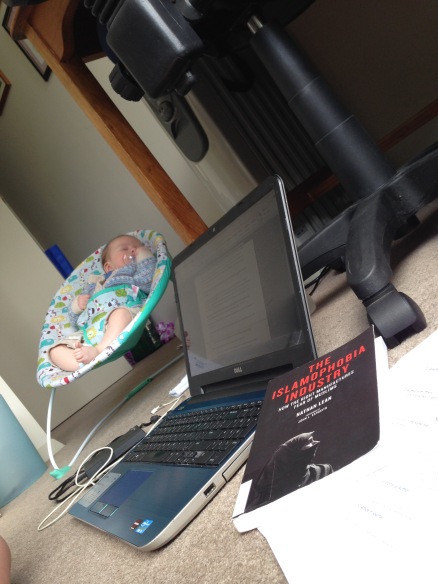
This was one method of essay writing; Moo fell asleep in his bouncinette once while I was sprawling through books trying to work on an assignment on the floor.
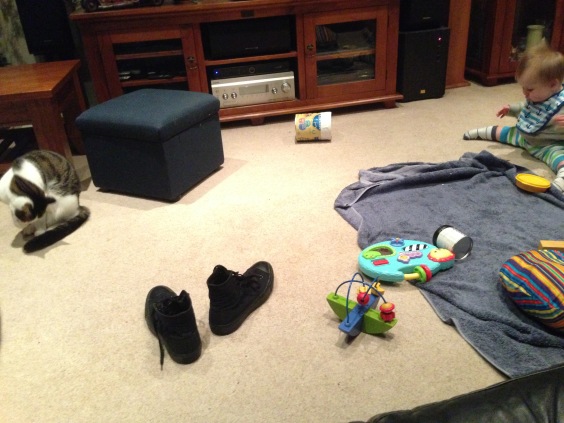
A lot of the time I find myself switching between my ‘mum’ headspace and my ‘student’ headspace so things can get done. To my classmates I am a regular student just like them, and it’s only when I talk to people that they realise and sit in slight astonishment that I am juggling study with raising an infant. As an undergrad and Moo being his age it is impractical to bring him to lectures meaning I am in constant reliance of my support networks to look after him. Over time, things have certainly become more manageable; I sit and write this on the couch while he eats crackers, stares at the cat, and pulls half the contents of the bottom of the DVD rack out and throws them on the floor. Needless to say he has now started working out how to move, and I spent much of my exam prep this trimester hoping he wasn’t going to learn how to crawl BEFORE my exam.
This was Moo as I was writing this piece; he shuffled off the towel, is secretly a gymnast with legs like that, and was trying to pick up a small piece of cracker on the floor. Had also thrown his homemade drum away made out of an old formula tin.
GirlGuiding has been a part of my life for over 15 years now, and the concept of leader’s daughters in units with me has been quite normal. A lot of leaders are typically mums, however being so young means many of the young leaders I work with are usually students or full time employed, maybe with a serious partner but no kids. Suddenly I’m an anomaly; 22 years old, well experienced, young leader, facilitating/attending/presenting trainings WITH an under 5! I emphasise with here, as in the course of his life, Moo has already come to weekend trainings, is down for two school holiday sessions coming up, and I’m sure a few more in the next few years.
I posted this photo on Facebook on the Sunday morning of my first weekend training, captioned: “There should be a blanket patch labelled ‘I survived a GirlGuide weekend as a trainer with a small child.”
Being a new trainer, plus learning the ropes with a very dependent young child makes anyone’s stress levels skyrocket. Attending a weekend training, let alone facilitating one, is another kettle of fish when it comes to having Moo coming along; sometimes I wonder who has more stuff packed in the car, him or everyone else. By the time all his clothes, port-a-cot, food, some toys, and pushchair are packed, then somehow it’s my personal bits, plus resources needed to bring along and so on to pack; there’s an entire house in a small car minus the kitchen sink and a fridge almost. (Although I’m getting really good at car tetris.) A conference I attended led me to be ‘that crazy woman pushing a pushchair up and down outside to get the baby to sleep’. Part of one weekend training involved sitting at the back of the room listening to presentations quietly, so to avoid the awkwardness of the occasional squeal or baby noise we sat at the back of the room listening while I bribed Moo with gingernuts on a blanket on the floor. That same weekend I was presenting two morning sessions; Moo was happily sitting watching me present when all of a sudden he fell down from sitting up and absolutely lost the plot while I was mid-sentence. Bringing such young children has become a rarity over time but now there are a couple of us who for one reason or another need to bring children along always/on occasion and that these other little people are a major part of our lives beyond GirlGuiding and they do need to come along and be involved in the training sphere sometimes. Bringing Moo along certainly has its challenges, but he has never hindered the ability to get things done.
Looking to the future is a hard and difficult one. My passions for a very long time have laid with the Pacific and Development, and really making a difference in the world. Once upon a time I saw myself ten years from now potentially returning to the academic sphere having ventured overseas once again and gained some real-world experience. Now as I save what I can from my benefit each week so that in the long run I can afford to buy my first home (big dreams I know, but you can’t give up on your dreams entirely) I’m faced with a future either working within the NGO sector locally for a salary less than ideal doing something I love, or adapt my skills into something else and start a career path down a different track, while committing my spare time into my passions. One day I’d love to return to the academic sphere to add to my study in a postgraduate form, but only when things are a little more stable.
Regardless of where the future is headed, there is one thing I know for sure. We cannot let children hold us back from chasing what we want to do, sometimes the better option is to let our children come along in the chase. From my perspective there’s a lot of occasions where we forget that other people have lives beyond the portion of their lives we know them from, and sometimes these intersect, and other times they are reason things do not happen immediately. Adaptability and flexibility is key, not only from a mother’s point of view but from an everybody point of view. I praise people like Lorena who have the ability to combine their interests with their children and also their professional life. As the concept of professional work changes and how it is represented, from flexi-hours to working from home, surely it is time to bring the sphere of children and where they fit in the bigger picture into it as well. What if we looked at others like real complex humans, with histories and stories untold, friendships and relationships we may not know about, and a vast array of experiences and needs; would our methods of recognising care, how we treat people, and how we go about and participate in our careers and lives differently? I certainly hope so.
As Convener of the AAA’s MIG (Melanesia Interest Group), I want to extend an invitation to all those attending the AAA 2015 meetings in Denver with an interest in Oceania to attend the MIG business meeting.
Date: Thursday November 19
Time: 6:15-7:30 PM
Venue: Room 706 of the Colorado Convention Center
Our meeting agenda is as follows:
Convener’s report
Incoming convener elections
Member updates
Proposal for discussion: that we change the scope and mandate of Melanesia Interest Group to become the Oceania Interest Group
Proposal for a 2016 AAA panel in honour of Nancy Sullivan
The preliminary programme for this year’s annual meeting of the American Anthropological Association (18-22 November) in Denver is out and looks great. With my AAA Melanesia Interest Group (MIG) Convener hat on, I have scanned through the programme and compiled a list of sessions, papers and meetings that will be of interest to people working in Oceania. I’ve cast my net slightly wider than Melanesia to include as many places in the Pacific as I could find, including Australia and New Zealand.
If I have missed anything please let me know so I can add it!
Anthropology, a discipline dedicated to understanding the full range of human experience from as many perspectives as possible, has always been comparative. This comparative aspect was one of the things that initially captured my imagination as a student. I became interested in understanding how issues that affect humans everywhere – such as poverty, inequality and development – appear in different contexts. I believe that to better debate such issues, we need to understand people’s practices as well as context-specific structures of history, environment, society, and culture. Careful comparative analysis can add to knowledge about development and social change by informing debates and contributing to more effective policies and strategies.
A while ago I wrote about the fieldnote template I used in MS Word for my PhD research. Now that I’m starting some new projects it’s the perfect time to try Evernote for ethnographic fieldnotes.
I have used Evernote for a while (mainly for storing annotations and web clippings) but I have to admit it wasn’t the first thing that sprang to my mind when I thought of switching away from MS Word for fieldnotes. I asked ethnographic researchers on Twitter to share what they used to take electronic fieldnotes, and Kelly Dombroski was the first to suggest I take a look at the possibilities Evernote provides for writing and organising fieldnotes. A quick Google search led me to a couple of useful blog posts by reseachers who use Evernote this way, including one by David Keyes on Evernote as Field Notebook where he talks about how he came to use Evernote for fieldwork and data analysis. Over on the Wenner-Gren Blog, Danielle Carr discusses how she became a “reluctant convert” to Evernote and outlines some advantages and disadvantages of using it. Taking a slightly different approach, Tim Sensing uses Evernote for a student ethnography assignment, something also suggested on a web page I found for the course Web 2.0 Foundations: A Networked Research Course describing how to take fieldnotes and write them up in Evernote.
Following on from my post last year, here is a list of theses (Masters and PhD) published in anthropology departments in Aotearoa New Zealand in 2014. My list includes all major universities except for Auckland University of Technology, not because AUT doesn’t offer anthropology (it does, in the School of Social Sciences and Public Policy) but because it takes an interdisciplinary approach and I couldn’t tell which of its theses were more or less ‘anthropological.’
I compiled this list by searching the New Zealand National Union Catalogue of the National Library of New Zealand, which holds masters theses and doctoral dissertations awarded by New Zealand universities. I also searched individual university library catalogues and online research commons. I used the keywords “anthropology” and “thesis” in my search. Some catalogues were more difficult to navigate than others and I had restricted access to several resources, so my apologies to those whose names I have missed. Please comment below if you have a thesis to add to this list or correction I need to make.
I was inspired by the conference theme and have developed the paper below (based on my PhD research) to focus on how grassroots organisations become responsibilized in the absence of effective state interventions in urban poor areas.
TITLE: Responsibilizing grassroots organisations in “forgotten places” in Howrah, West Bengal, India.
ABSTRACT:
In 1991 the Government of India implemented widespread economic liberalisation policies which, as well as contributing to India’s recent economic rise to global significance, had important and uneven effects on various social groups within India. Despite official reports of declining poverty in India, neoliberal ideas and policies have not improved the lives of those living in poverty – many of whom are Muslim – in bastis in Howrah, West Bengal. This paper argues that Howrah’s bastis are “forgotten places,” historically and politically constructed enclaves that are neglected, but nevertheless deeply inhabited, by the state. In these bastis, services that are the responsibility of the state – such as access to education – are not adequately provided for, leaving a gap that NGOs and grassroots organisations try to fill. This paper provides an ethnographic account of what happens in such “forgotten places” by describing the efforts of Howrah Pilot Project, an organisation that seeks to address this gap by running a grassroots-level, nonformal school in one of Howrah’s bastis. Processes of ‘active forgetting’ serve to responsibilize such organisations, but their practices need to be augmented by a responsive state in order to achieve meaningful, long-term, beneficial change.
A month or so ago I posted some thoughts about what it’s really like to be an anthropologist. Not long after that I was asked to talk to a group of Y12 students (high school students in their penultimate year who had come to Victoria University to learn about future study options) about doing anthropological fieldwork. That talk did a much better job of capturing what for me is one of the most rewarding (and challenging) parts of being an anthropologist: doing fieldwork.
I studied Hip-Hop Culture in Aotearoa for my Masters degree in social anthropology, which involved doing fieldwork ‘at home.’ I had long been a fan of Aotearoa Hip-Hop (I used to co-host the Hip-Hop show on Massey University’s student radio station Radio Control) and became interested in understanding how and why Hip-Hop in New Zealand was different to Hip-Hop overseas, particularly the United States. My thesis was based on three years of ethnographic fieldwork (2000-2002) where I explored what Hip-Hop meant to those actively involved in producing and performing Hip-Hop in Aotearoa.
My fieldwork involved a lot of listening and observation. I went to events (b-boy and MC battles, graffiti showcases, gigs, Aotearoa Hip-Hop Summits), used a technique called participant-observation (sometimes known as ‘deep hanging out’ with a purpose) where I would participate in as well as observe what was going on, took fieldnotes and photos, interviewed members of the Hip-Hop community, and tried to immerse myself in all things Hip-Hop.
Lorena doing fieldwork at the 2001 Aotearoa Hip-Hop Summit in Auckland
People often smile when I tell them my fieldwork involved going to gigs or watching spraycans while people created graffiti art (making jokes like “I bet that was hard work”). However, this kind of fieldwork is not as easy as it sounds. Daniel Simons’ video The Monkey Business Illusion is a great example of how we often miss a lot of what happens around us: Continue reading