Teaching “Anthropology for Liberation” in 2025 with “The Good Ancestor Game” by Tina Ngata and Tāwhana Chadwick

This is the final post in a three-part series reflecting on changes I made to my undergraduate course Anthropology for Liberation at Te Herenga Waka in 2025. Part I focuses on the work that reading lists do in a course, and Part 2 discusses changes I made to the course assessments. Here I reflect on what I learnt from bringing “The Good Ancestor Game” by Tina Ngata and Tāwhana Chadwick into the class. This post incorporates content from “The Good Ancestor Game,” a role-playing game licensed under Creative Commons BY-NC-SA 4.0. This post is shared under the same license.

Why “The Good Ancestor Game”?
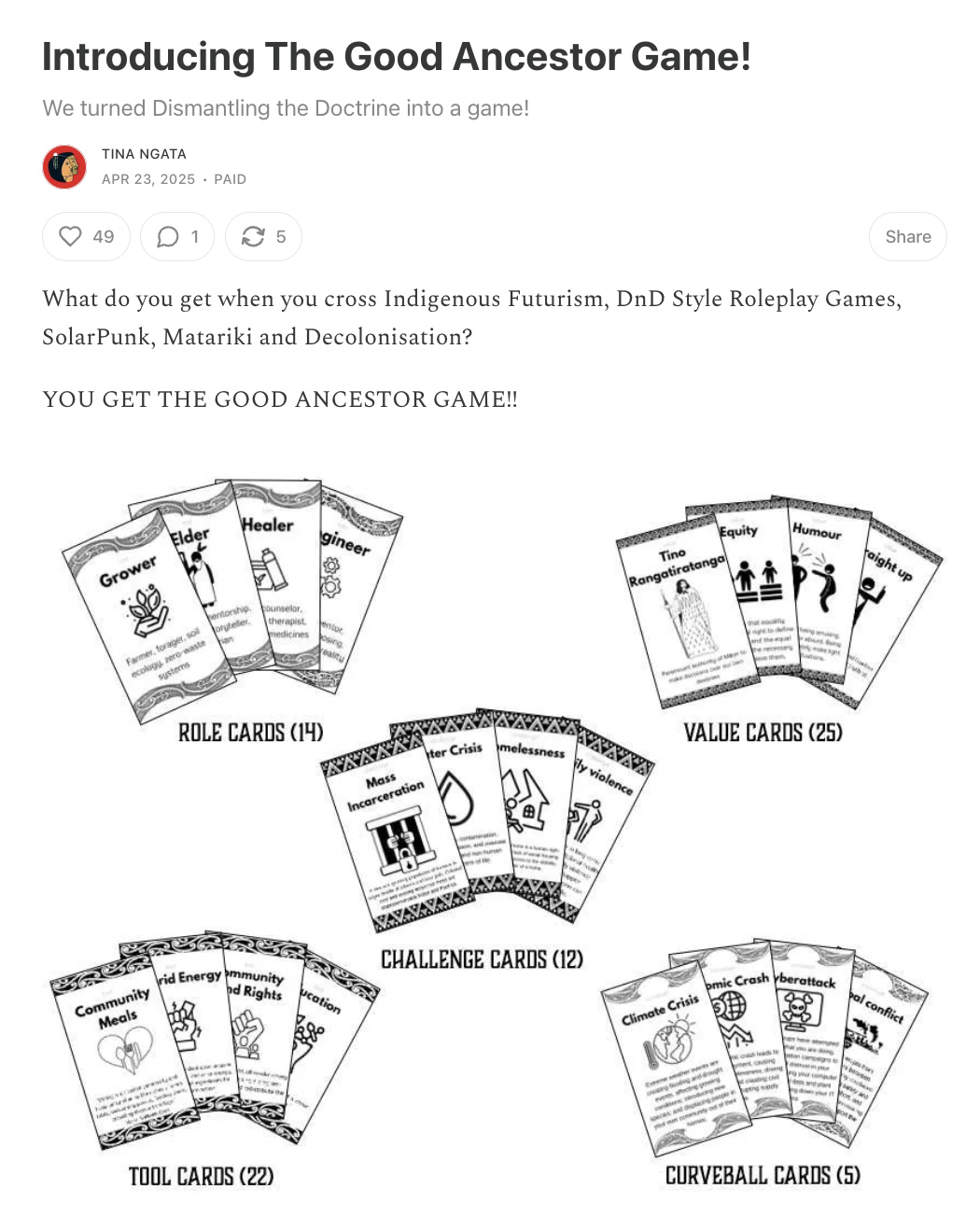
Screenshot of Tina Ngata's Substack post 'Introducing The Good Ancestor Game,' showing sample role, value, challenge, tool, and curveball cards from the game.
https://tinangata.substack.com/p/introducing-the-good-ancestor-game

We played this game during a two-hour seminar in Week 5 of the 12 week course, when we were in the middle of reading Ranginui Walker’s Ka Whawhai Tonu Matou. The previous week had discussed the first ‘era’ of the book, where Walker discusses how Māori became tangata whenua of Aotearoa, the arrival of Pākehā and tauiwi settlers, and the signing of Te Tiriti o Waitangi. When Tina Ngata shared “The Good Ancestor Game” earlier in the year, I immediately thought to put it into conversation with Walker’s chapters on power and resistance, and this is how I introduced it to the class. I argued that “The Good Ancestor Game” is an example of survivance, and that playing this game in class allowed us to experience Māori storytelling and collective problem-solving through Māori values.

Survivance (and thrivance)

Survivance, a term coined by Gerald Vizenor, offers a theoretical framework for understanding Indigenous experiences that moves beyond deficit narratives of victimhood and tragedy. Instead of viewing Indigenous peoples as passive recipients of historical trauma, survivance recognises the active, ongoing resistance and cultural vitality that characterizes Indigenous peoples worldwide.

“Theories of survivance are elusive and imprecise by definition and in translation. The practices of survivance, however, are obvious and unmistakable in native stories. The nature of survivance creates a sense of narrative resistance to absence, literary tragedy, nihility, and victimry. Native survivance is an active sense of presence over historical absence, the dominance of cultural simulations, and manifest manners. Native survivance is a continuation of stories.”

Vizenor, Gerald. 2009. Native Liberty: Natural Reason and Cultural Survivance. Lincoln and London: University of Nebraska Press. Page 1. 

Survivance as theorised by Vizenor is specifically for Native American and other Indigenous contexts, and doesn’t automatically travel to all experiences of colonisation and oppression. It is important not to collapse different experiences of oppression or assume one theoretical framework fits all contexts of resistance, and to think carefully and critically about the concepts we use. Even though Walker himself never used the term, Ka Whawhai Tonu Matou is, to me, a clear example of survivance in practice. “The Good Ancestor Game” is as well, with its stories of navigating crisis through community, tikanga, and collective resourcefulness. When I teach with the game in a future iteration of the course I’ll add “thrivance” to the theoretical mix:

The concept of thrivance handily picks up where survivance leaves off: both are valuable analytical tools, yet different chapters of the ongoing story of Indigeneity. A thrivance focus is important as it moves beyond the survival statement of “we are still here” to “we remain productive, successful, and vibrant contributors in today’s world” (Baumann, 2019, p. 19).”

Baumann, Dianne F. 2023. “Thrivance is My Identity: Moving Beyond Survival.” Journal of Ethnic and Cultural Studies, 10(4), 1–12.

Indigenous Futurisms

As Ngata explains in her Substack post, she and Tāwhana Chadwick developed “The Good Ancestor Game” in 2025, as part of their “Dismantling the Doctrine of Discovery” training programme. In a Facebook post describing the game, Ngata describes it as a cross of “Indigenous Futurism, DnD Style Roleplay Games, SolarPunk, Matariki and Decolonisation” (Ngata, 23 April 2025).

Indigenous futurisms is a term coined by Grace Dillon, who developed it in relation to Afrofuturism and Vizenor’s concept of survivance to capture Indigenous perspectives on science fiction, speculative storytelling, and world-building that can be seen in all kinds of creative works. I introduced Dillon to my class here partly to bring her into the citational lineage we were building across the course, and partly because I knew some of my students, being interested in science fiction, would want to look her up themselves.

I also connected Indigenous futurisms to a whakataukī that Ngata shared in her Facebook post announcing the game: “Te pae tawhiti, whāia kia tata – te pae tata, whakamaua kia tina!” I found more than one translation of this in looking up its meaning: Professor John Moorefield translates it as “Strive for long-term goals while ensuring that short-term goals are also achieved” in his 2001 inaugural professorial lecture; the Ministry of Social Development’s website translates it as “Seek out the distant horizons, while cherishing those achievements at hand”; and Sport New Zealand Ihi Aotearoa translates it as “The potential for tomorrow depends on what we do today”. For me, this whakataukī expresses both the decolonised, Tiriti-centric future that “The Good Ancestor Game” envisions, and the immediate, practical steps we can take now toward that transformation.

Playing “The Good Ancestor Game”

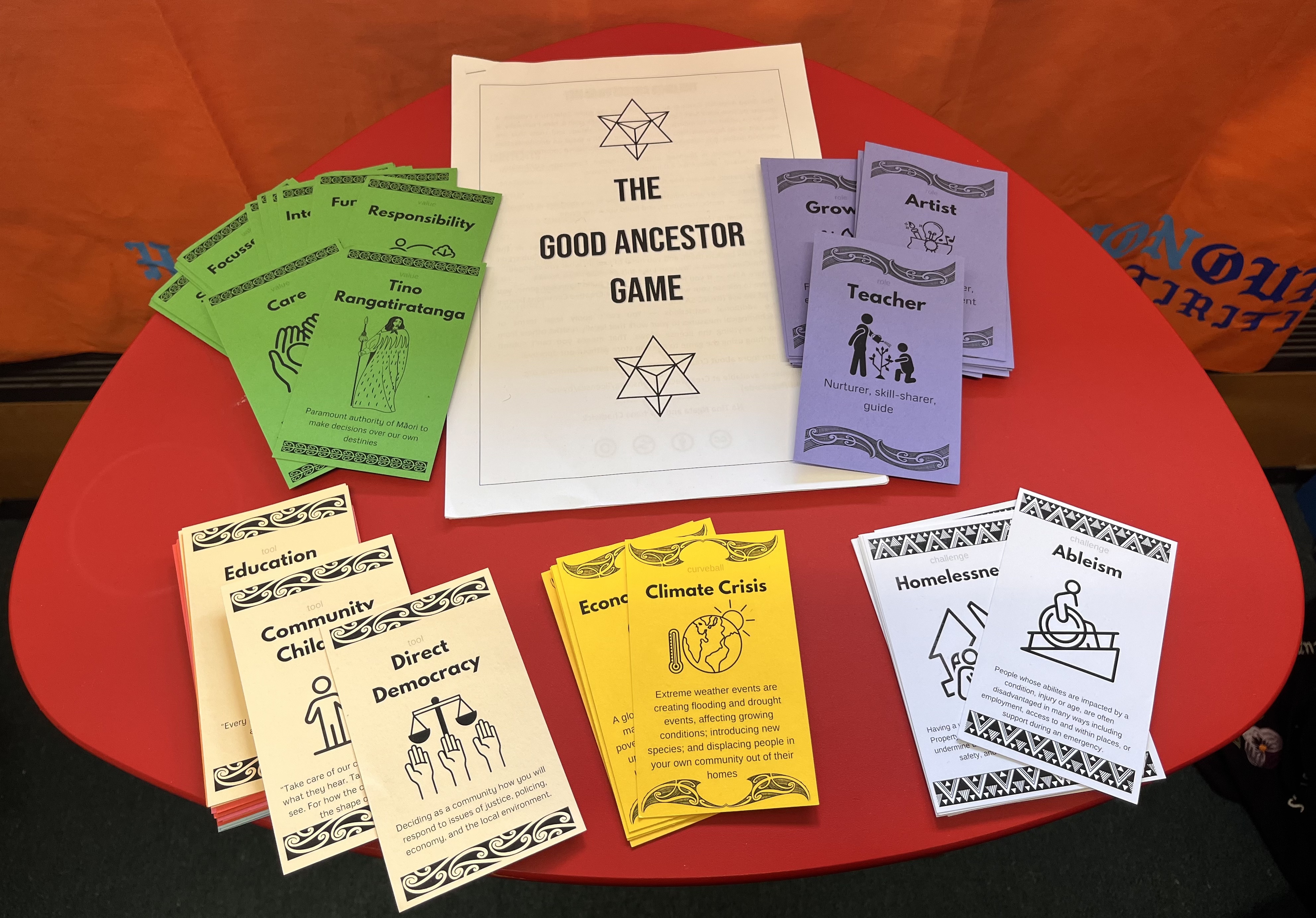
The game is free to download and use so I printed everything out beforehand and made different coloured decks for the five different categories of cards: role cards, value cards, challenge cards, tool cards, and curveball cards. Before we started playing, I invited students to practise cultural anthropology’s hallmark research method, participant-observation, by participating in the game while observing both how they were participating, and how the game itself unfolded. I asked them to pay attention to how they could bring course themes into the game; how collective storytelling differed from individual analysis and what that might suggest about different ways of knowing; what survivance looked and felt like in the game; how their own cultural background shaped their approach to the game; and how easy or difficult they found playing it in class.
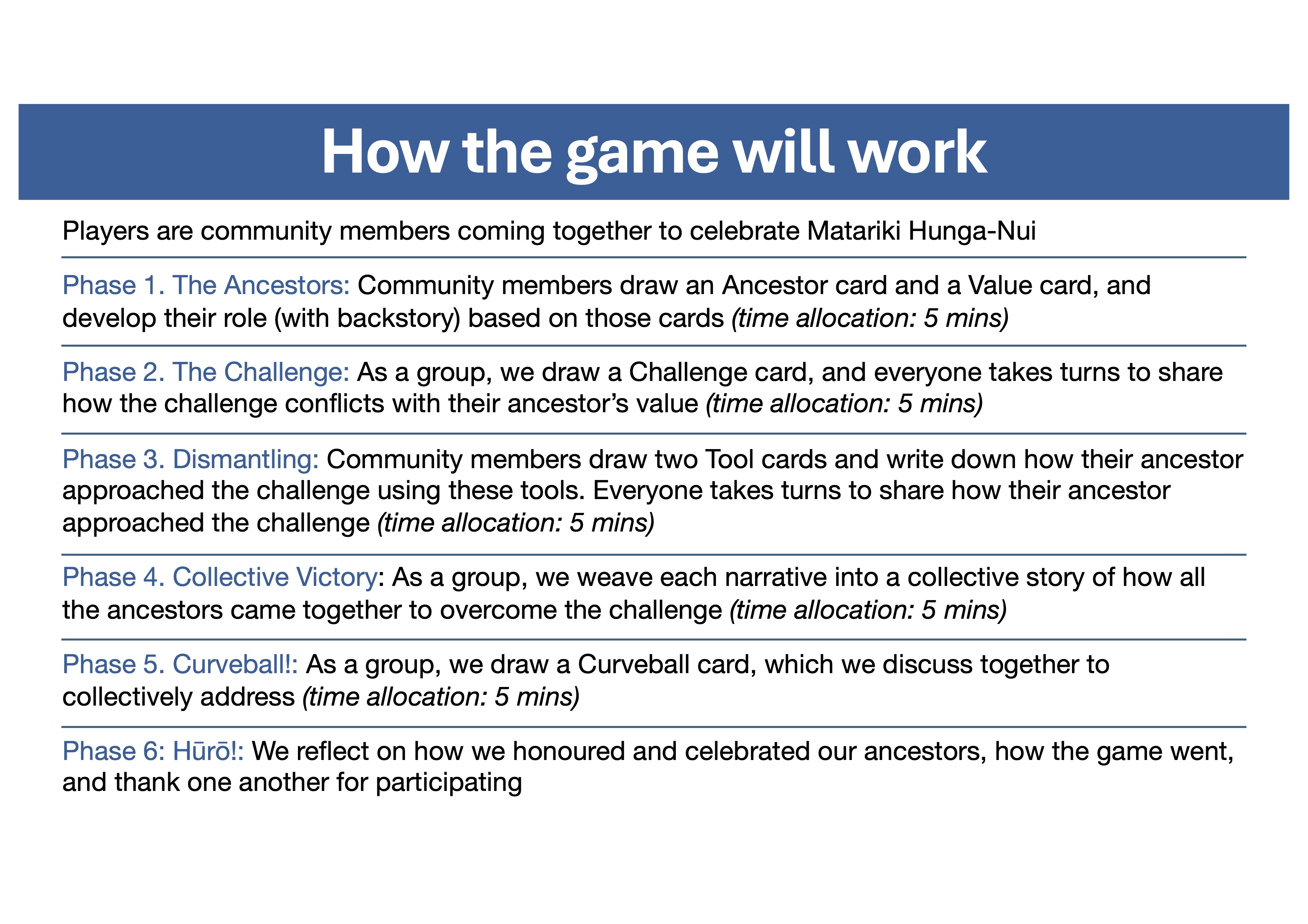
I’d read through the guidebook carefully and rather than hand that out to the class, I created a set of PowerPoint slides to introduce the game’s mechanics. I talked the class through how the game will work (see slide above), then we followed the guidelines to discuss kawa and tikanga and modified consensus decision-making as foundations for our game.

“Community members should discuss kawa and tikanga at the beginning of the celebration.

Kawa are hard boundaries around themes or ideas that we do not cross. Breaking kawa may mean redrawing a challenge card. E.g. we do not attack, or belittle each others’ ancestors, we do not weaponise colonial harm (like war or prisons) to “solve” curveballs.

Tikanga requires further discussion and help to guide the game but are not the focus of the story i.e. violence can be alluded to but not described in detail.

Kawa and tikanga can be introduced for discussion at any point in the game, by any member, and are passed by consensus of the group, i.e. they can be passed unless there is a good reason not to.

Remember, respecting human dignity is more important than the outcome of any given scenario” (Ngata and Chadwick, 2025).

Since we were working in a large group, I made two decks of Ancestor (role) cards, distributed them to the class, then asked everyone to find the classmate with the matching Ancestor card so they could develop their character together. Once they had done that, they drew one Value card per Ancestor and prepared a short introduction to share with the class, giving their Ancestor a name and explaining how their background connected to their value – the guidebook’s example was very helpful for this. Pairing up worked well because we had some experienced gamers in the class whose enthusiasm and knowledge quickly put those new to role-playing games at ease, facilitating good discussions and creative character-building. I had been a bit anxious about introducing a role-playing game to the class but those present committed to the experience and we moved through the rest of the game’s phases (the Challenge, Dismantling, Collective Victory, Curveball, and Hūrō) with lots of discussion. One of the students (an avid gamer) shared the character notes they had developed with their classmates – reproduced here with permission – which give a good sense of the depth of engagement the game generated:

Kimihia (They/Them)

Role: Agitator

Value: Self Determination

Backstory: Māori from the inner city. Got their start in activism by helping to knock statues of racists down and using the stone they were made from to help rebuild the shoreline to help with erosion, and planting trees where the statues once were. They have a problem where they want to do everything but then often end up doing nothing. Also has ADHD and anxiety.

Challenge (Food Scarcity):

Sees how the lack of energy from starvation means that people can’t fight for themselves. Lack of food as a means of population control by a government who benefits from them not having the energy to do anything more than work and sleep.

Constantly thinking of food means they can’t focus on other things. Becomes isolationist and protective over their food and resources.

Tools (Broadcasts & Equipment Library):

They started to reroute water with broken statues.

Uses the book in their library to learn how to garden using the tools to do so, including how to reclaim soil and seeds.

Went on Manu’s [another Ancestor/character in the game] show to let people know how to do the same and answer questions they may have about starting.

Self-Determination trait comes in as they are doing this outside of government control, with the community. Uses cracked statues that are too small to reroute water to filter the water. Limitation of only knowing how to do the basics and it’s not enough to help everyone.

Playing this game in class was the highlight of my 2025 teaching year. Several students stayed afterwards to continue discussing the game, saying that the experience reminded them of what they enjoyed about high school – the imagination and creativity, collaborating with me and one another, and having fun in the process. It also gave them a practical feel for the kind of game they were invited to develop for their final research projects (which I discussed in Part 2 of this series). “The Good Ancestor Game” is very playable and an excellent fit for the themes of Anthropology for Liberation, and I’ll definitely bring it into future classes.
Teaching “Anthropology for Liberation” in 2025, Part 1: What reading lists communicate

This year I taught my undergraduate course Anthropology for Liberation at Te Herenga Waka—Victoria University of Wellington after a two year break. As readers of this blog will know, I regularly post about the readings I assign and the assessments I design for this course. Like previous iterations, this year I modified the course in response to the current academic and political climate, student feedback, and ongoing scholarly conversations about what it means to practice an anthropology “designed to promote equality- and justice-inducing social transformation,” as Professor Faye V Harrison (1991, 2) – whose edited book this course is named after – describes it.

This is the first in a three-part series reflecting on changes I made in 2025. This post discusses what happened when I dropped a book from the reading list. Future posts will explore how I redesigned assessments (including AI reflections and game design options) and what I learned from introducing role-playing games in class. Some of these changes worked well, while others taught me an important lesson about the gap between pedagogical intentions and outcomes.

Changing the course readings

What does it mean to teach a course titled “Anthropology for Liberation” while watching genocide unfold in real time on our phones, navigating AI-generated misinformation, and grappling with what feels like an accelerating unraveling of democratic norms? This question troubled me as I prepared the course. I decided to address it at the outset by adding new readings to Week 1. However, this created a practical problem: I had developed the course to use a close reading approach I outlined in a previous blog post, which involved assigning four books to read throughout the trimester and working through them in class. Adding new readings at the start would push the books back in the schedule, and previous feedback from students indicated that working through a book in the final weeks of the trimester was unsatisfying because they were so focused on assignments that they weren’t able to meaningfully engage with it. So, I decided to drop one of the books from this year’s reading list.

What I added to Week 1:

  • Tolentino, Jia. 2025. My Brain Finally Broke. The New Yorker.
  • Harrison, Faye V. 2025. “Afterword: Toward an Anthropology of Liberation.” In The Anthropology of White Supremacy, edited by Aisha M Beliso-De Jesús, Jemina Pierre, and Junaid Rana, 361–72. Princeton, New Jersey: Princeton University Press.

In our first seminar, I addressed the challenges of teaching a course like this in the current moment by doing a close reading of these new readings. I selected a series of quotes from each piece and read them aloud in class, pausing to discuss the work that a particular word or sentence was doing and to connect it to our course. I started with Jia Tolentino’s comments about phones as “time-eaters”:

The phone eats time; it makes us live the way people do inside a casino, dropping a blackout curtain over the windows to block out the world, except the blackout curtain is a screen, showing too much of the world, too quickly. As Richard Seymour writes in the book “The Twittering Machine,” this avoidance of time’s actual flow, this compulsion toward the chronophage, the time-eater, is a horror story that is likely to happen only “in a society that is busily producing horrors.” (Tolentino 2025)

This prompted students to discuss how they use their phones and the disorienting experience of scrolling through images of hospitals being bombed and screaming children in Gaza alongside influencer content. Several students spoke about the desensitisation to suffering that can occur when such images go viral, while also acknowledging the privilege of being able to scroll past at all. They also made connections with Palestinian solidarity events here in Aotearoa and the November 2024 Hīkoi mō te Tiriti.

The discussion we had led nicely into the quotes I selected from Faye Harrison’s chapter, including her observation that “White supremacy, accumulation by dispossession and expropriation, and the ecological crises of environmental injustice and climate change are global problems that cannot be dealt with simply within nation-states. We have to build multilevel and multilateral bridges that will permit activists to combine forces in greater measures of unity despite the differences and distances between us” (2025, 369). Harrison also argues that “As individual scholar-activists but especially as participants in wider collectivities and coordinated webs of connection, anthropologists have the capacities to align themselves with, become accomplices with, and advocate on behalf of sociopolitical processes aiming to effect meaningful, substantive change” (2025, 370). Working through these quotes helped set up the guiding framework for the trimester.

What I removed from the reading list (and how it affected the course):

The book I chose not to read this year was Ashanté Reese’s 2019 Black Food Geographies: Race, Self-Reliance, and Food Access in Washington, D.C. In previous years, this book worked well alongside the collaboratively authored Imagining Decolonisation (which provides an excellent introduction to ideas of decolonisation as they play out in Aotearoa); Ranginui Walker’s Ka Whawhai Tonu Matou: Struggle Without End (often described as one of the best histories of Aotearoa and which I think makes a key intervention in how we think about history, oppression, power, resistance, and sovereignty in Aotearoa); and Camellia Webb-Gannon’s Morning Star Rising: The Politics of Decolonization in West Papua (about West Papuan struggles for independence). These four books illustrated how decolonisation and liberation movements take different forms in different contexts, moving from Aotearoa to West Papua and the United States and encompassing Indigenous sovereignty movements, ongoing struggles against settler-colonialism, and Black liberation and food justice.

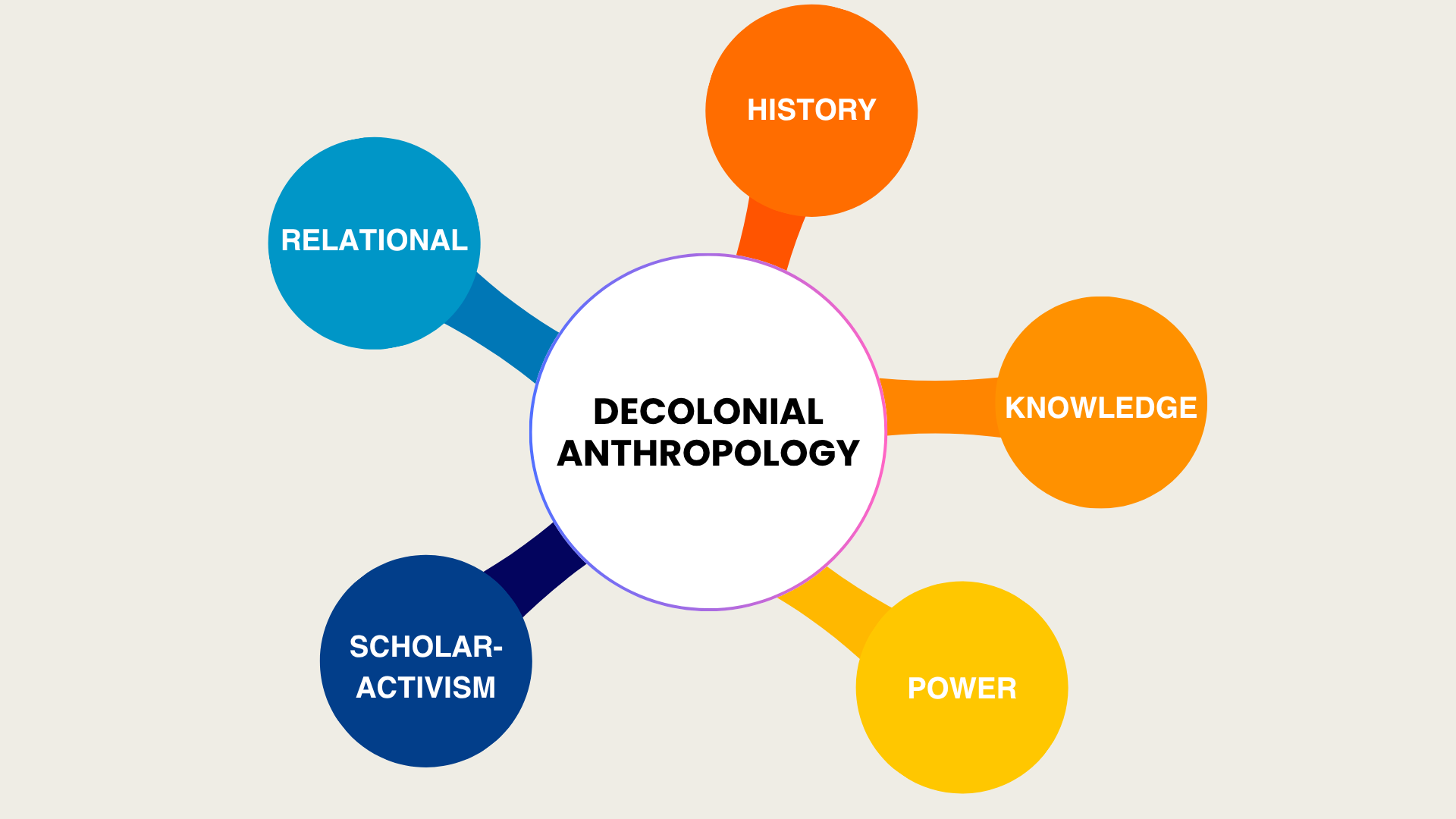
I didn’t realise the consequences of this decision until a student pointed it out to me. We were meeting to discuss potential research project topics and he noted that all three books centered Indigenous sovereignty and liberation movements. He wanted to focus on queer liberation and asked whether I might recommend some books to read about that. His question stopped me short, and I suddenly understood what dropping Black Food Geographies had done for the course. I was teaching as if I still had that book on the reading list and hadn’t adjusted my lectures, which meant that I was introducing students to key course concepts almost exclusively through the lens of Indigenous sovereignty and liberation movements. The decolonial anthropological framework I had developed for the course (Figure 1 below) was designed to apply across diverse liberation struggles (environmental justice, labour movements, abolitionist work, queer liberation, disability justice) but the reading list only included Indigenous case studies.

Elements of a decolonial approach to anthropology, by Lorena Gibson 2025
A decolonial approach to anthropology, © Lorena Gibson 2025

I shared his observation with the class during our next lecture, explaining what I had done and the unintended outcome. I also said that I had designed this framework to be applied in a variety of contexts and wanted to show how it travelled, and asked the class if they would be interested in spending the last couple of weeks focusing on disability justice. They were, so I assigned the documentary Crip Camp: A Disability Revolution as our reading and wrote a lecture to illustrate how the same analytical questions that helped us understand patterns in Māori sovereignty and West Papuan liberation movements can also reveal patterns in disability justice movements.

I also asked the class for their thoughts about the close reading approach I had been using. Students appreciated the depth of engagement with each book and valued working through them together in class, but many said they were overwhelmed with the amount of reading required and struggled to keep up. They suggested that journal articles, book chapters, or podcasts would be more manageable as they could engage with shorter pieces without the pressure of feeling like they were “failing” if they didn’t finish an entire book. This year’s experience has convinced me to completely redesign the course reading list the next time I teach it.

This experience taught me an important lesson about curriculum design: reading lists make their own arguments about what counts as knowledge, independent of what instructors say in lectures. If you have had a similar experience of course readings communicating something other than what you intended, I would be keen to hear how you navigated this challenge. I’d also love to hear from you if you have taught – or been a student in – a class that experimented with different approaches to course readings.

Why I use social media in teaching

I used social media a lot while I was working on my PhD. I visited blogs dedicated to the joys and pains of thesis writing (such as The Thesis Whisperer), used the Twitter chat channel #PhDchat to connect with others working off-campus most of the time like I was, and surfed YouTube channels looking for interesting videos related to anthropology. I came across a short video called A vision of students today by cultural anthropologist Michael Wesch which revolutionised the way I thought about social media and why I should use it as a teacher.

I sought Wesch out on other social media platforms and was struck by his approach to new media and philosophy of anti-teaching:

“Anti-teaching is about inspiring good questions. Since all good thinking begins with a good question, it struck me that if we are ultimately trying to create “active lifelong learners” with “critical thinking skills” and an ability to “think outside the box” it might be best to start by getting students to ask better questions.”

Wesch goes on to note that many students – especially those in large introductory classes – rarely ask ‘good’ questions and instead ask questions like ‘what do I need to know for this test?’ I have heard this a lot and it always makes my heart sink a little. I know studying is hard, especially when you have to juggle full-time study with work and family committments, but to me this question feels like another way of saying ‘I want to make sure I don’t accidentally learn too much so please tell me exactly what you want to see in my work.’ Wesch’s strategies for encouraging ‘good’ questions – especially his World Simulation for first year cultural anthropology students – resonated with my own teaching philosophy, which is based on educationalist Paulo Freire’s approach.

Today social media is an important part of my teaching practice. I use social media as a pedagogical tool to take learning beyond the classroom, teach transferable skills, encourage reflexivity and critical thinking (by having them look at how and why they use platforms like Facebook), and to model how anthropologists can use social media. (I’ll talk about how I use social media in another post.)

I also use social media for my own professional development. It is a great way to learn about what other anthropologists are doing in the classroom, to source new ideas and teaching materials, and to engage in online conversations about teaching anthropology. It is particularly good for networking and I have had conversations with Mike Wesch about adapting his World Simulation for the large first-year cultural anthropology class I teach at Victoria University.

I am curious about the reasons why others use social media in teaching. Why do you use it? Why don’t you use it? I’m sure I could learn a lot from your practices!