Advice for PhD students approaching the examination process in Aotearoa New Zealand (or other contexts featuring external examination of theses), by Dr April K. Henderson

I am delighted to share this invaluable resource from my friend and colleague, Dr. April K Henderson. April has written the most thoughtful and practical advice I’ve seen on navigating the PhD examination process, which involves a viva/oral defence here in Aotearoa New Zealand. Her advice is grounded in years of supervisory experience in Pacific Studies at Te Herenga Waka—Victoria University of Wellington, and exemplifies her generous mentorship. If you or someone you know is approaching a thesis examination in Aotearoa New Zealand, this is essential reading.

Approaching examiners’ reports

Your first and lasting response to examiners’ reports—even the one with the toughest-to-take criticism—should be gratitude for the detailed engagement with your work they provide. Let’s face it: reading a thesis, even a beautifully written one, is a bit of a slog, but these three people read yours, re-read it, thought deeply about, formulated opinions and crafted several (or five, or sometimes even eight) pages of detailed discussion and advice. No one else, apart from your supervisors, will read your work this closely.

Examiners are people, and just like other people we know (friends, relatives) some examiners are better at wording their critiques in a generous and supportive way, while others may be more blunt. Some critiques you may easily see the truth of, others you may reject. But no matter how they sound, examiners’ comments are always (at least in my experience) intended well and meant to improve your thesis. Therefore, the first note you should sound in the oral exam is gratitude that these esteemed, busy people have given so much time and attention to your work.

In your oral exam, you will need to be prepared to address critiques in your reports. Here’s some strategies for preparing to do that.

So you have your examiners’ reports—what to do now? 

I advise students to work your way methodically through all the reports, developing a list of every critique/request made and who made it. More specifically, I suggest developing a spreadsheet with three columns.

In the left column of the spreadsheet, enter each critique/request in a new row.

In the middle column, write a statement about whether the critique was echoed or contradicted in the other two reports. Why this middle column is important:

  1. It will help identify the key areas of agreement across all three reports, and these will most likely feed into predictable questions in the oral exam and possibly revisions you will be asked to make;
  2. It will help you to have perspective on the reports when taken as a whole. Otherwise, our natural human negativity bias means that we will obsess about the most critical bits in the reports, losing sight of the big picture—including that some examiners may have loved the exact same aspect of the thesis that another hated. So Professor X thought you did a really poor job elaborating [key concept] in your thesis. But Professor Y and Dr Z thought you did a great job and said so! This middle column can help your fragile scholarly ego maintain perspective. It also can suggest positive strategies for approaching the stinging bits of critique in the oral exam: if examiners’ responses were contradictory on a particular point, it can be useful to gently (and non-defensively!) work a reference to the positive commendations of other examiners into your considered response to the critique (a suggestion for doing this below). Which brings me to the final column…

In the right column, put your carefully considered response to the critique and what (if anything) you are willing to do to address it, including practical changes you might make to the final thesis. Also note for yourself if/how you might (implicitly or more directly) work a reference to the critique in your opening fifteen minute presentation. (More about how you will use and draw on this column is at the end of “The Oral Exam” section).

Here is an example of a table of examiners’ comments and student responses. (Note: this is an anonymised, generalised composite, not a particular student’s exact spreadsheet).

CRITIQUECONVERGENCE/DIVERGENCE in REPORTS?MY RESPONSE
1. One examiner said thesis invokes divergent conceptions of [key concept] from multiple theorists and “the way in which [key concept] is being used as expounded in Chapter 2 and especially in later descriptions and analysis could have been clearer” (Professor X  p2)Critique not reflected in Professor Y’s or Dr Z’s reports, who write approvingly of thesis’s use of [key concept]:
“[insert their flattering, approving statements here]”.
Two examiners were very satisfied with my treatment of [key concept]. I can offer an implicit response to Professor X’s critique in my opening 15-minute presentation in the oral exam; As part of narrating the thesis’s key original contributions, I can say something like: “I agree with examiners that the concept of [key concept] is critical to the thesis. It underpinned my analysis of x and y and allowed me to see z. Given its importance, I was gratified by Professor Y’s and Dr Z’s commendations of how the thesis introduces and uses the concept.”
 
If Professor X raises a specific question later in the exam, I am prepared to restate/elaborate clearly on the thesis’s use of [key concept], making reference to particular passages in the thesis that I feel address Professor X’s questions.
Ways to do this non-defensively: open the response by agreeing with X that clarity is important. After pointing to specific passages that I hope address X’s critique, close by welcoming suggestions X may have for bringing further clarity.
2. “Textual descriptions of x and y are rather hard going” (Professor X  p2)Critique not reflected in Professor Y’s or Dr Z’s reports. Both of these other examiners are trained in [specifically relevant field] and write of the thesis’s textual descriptions in very positive terms: “[insert their flattering, approving statements here]”.Professor X’s critique seems a bit pointed here—it’s very specific and not shared by the other examiners who have more expertise in [relevant field]. I don’t think I need to pick up on it in my opening presentation.
 
If it comes up later in the exam, I could discuss why I chose to describe x and y in the level of detail I did, the relationship of these descriptions to my analysis, and end by acknowledging with gratitude Professor Y’s and Dr Z’s commendations of my descriptions in their reports.
3. “The Conclusion [was short]. I craved more. What I expected here was a greater connection between the research questions posed at the start, the subtle exposition of complex theories, the graphic depictions of [thesis content], the lived realities of [thesis participants] than is presented in these short, final paragraphs. This was a profound disappointment and I can only presume that the author ran out of time or energy. This deficiency might be redressed in the final version.”
 (Professor X  p7)
While phrased more generously, the other examiners agreed:
 
“The thesis concludes with a short chapter that briefly summarises [xxx], reiterates the central argument, and sketches some preliminary ideas for future research.” (Dr Z p4)
 
“[The student] might well want, in any future revision, to expand and amplify the thoughts indexed in their concluding chapter.” (Professor Y)
This critique was shared across all reports and is likely to come up in oral exam. I agree with examiners that my Conclusion was too short. It was not a matter of running out of time or energy, though—just running out of word limit.

I think there’s a way to acknowledge this shortcoming of the thesis towards the end of my opening 15-minute presentation, and to do it in a way that explains this shortcoming as an unfortunate by-product of what examiners appreciated as the strengths of the thesis: all of the rich detail in the substantive chapters meant that the thesis was at the maximum word limit.
 
In terms of practical steps to address what we all agree was a shortcoming in the thesis: prior to the oral, I will gain clarity from FGR on whether the revised, final (post-exam) thesis can exceed the 100,00 word limit – if so, I will readily offer to expand the Conclusion. If not, I will explain the word constraints to examiners and seek their advice on parts of the thesis they think could be sacrificed to make space for an expanded Conclusion.

Once you’ve got a draft of this spreadsheet, circulate it to your supervisors in advance of your preparing-for-the-oral-exam meeting. When you meet, supervisors can help you go through the list and provide additional guidance on ways to approach responses to critiques in the oral.

Note that this table is a tool for you to help make sense of the examiners’ reports and prepare in the lead up to the oral exam. More about how to use this table is at the end of the next section.

The oral exam

Your opening 15-minute presentation

At the start of the oral exam, after the chair has welcomed everyone and discussed the general process, you will be invited to make your opening remarks (at our university, these are usually limited to fifteen minutes). In your opening remarks, what you want to do is: 1) thank the examiners for their careful consideration, 2) tell them the story of your thesis (how it came to be what it is, what it accomplishes, and why it matters), and then 3) end by explicitly welcoming the ensuing discussion and questions as a valuable opportunity to improve your work.

Discussing each of these, in turn:

First, re-read the opening lines of “Approaching examiners’ reports…”, above. Gratitude should be the opening note you sound in the oral exam. You will never again in your life have this many people focused solely on you and your work (even if you write a book, you’ll just get peer review reports—not the additional benefit of getting to talk to those people for 2–3 hours about your work in person and explain why you wrote what you wrote). Even if you disagree with some of their comments/critiques; even if you think one or two of them don’t “get” your work, express gratitude for their careful consideration of your work—they really do intend well (in my experience).

Second, I usually advise students to think of this opening presentation as a chance to tell the story of your thesis. Of course you will want to ensure clear statements about the thesis’s key arguments and original contributions to knowledge, and especially why it matters, but this is also a chance to contextualise the thesis. This is a chance to narrate why and how the work they’ve all read came to be what it is. It’s quite common for examiners to simply be curious about some things that may not be explained in the thesis: they’ll have questions about certain decisions you made to zig instead of zag, why you went here and not there, or how you ended up in this research area in the first place.

Of course, there are endlessly different ways to tell a story, including the story of your thesis. Take your cue for what parts to emphasise by what’s in the reports. For example:

  1. If a common question or critique emerged across the examiners’ reports about an aspect of the thesis (for instance something in the research design: where you went, who you talked to, how you talked to them, what theoretical concept was centred, what archives you consulted; or some key consideration that they thought was missing; or even why the thesis was structured like it was), and you can work an explanation of this into “the story of your thesis,” do it! I’ve seen examiners’ concerns about something melt away when they hear the backstory of why the student chose to do it like they did. Just hearing that the decisions were carefully considered and that the student had good reasoning behind them can sometimes appease examiners, such that things they raised as big concerns in their reports are no longer concerns (or even mentioned) in the recommendations for final revisions.
  2. Sometimes, if it’s not clear in the thesis, examiners will want to know more about you and how you came to do this research (at least in my field of Pacific Studies, people’s personal stakes in the work usually matter). I recall two of my past PhD students who both produced theoretically nuanced, ethnographically rich, and immaculately written theses, but both chose, for various reasons, to give minimal details about themselves in their theses. In both cases, multiple examiners came back asking them for more discussion of their relationship to the research topic. Partially this was about ethically disclosing their positionality, but partially it was also curiosity: how did someone who appears, on the surface, to be so different from this research context come to be studying this specific thing? So when one of these students crafted his opening presentation, he devoted some time to telling his coming-to-the-thesis backstory (aspects of which I’d never even heard, as his supervisor) and examiners seemed delighted to hear it: it was like, Ahhh, I get it now! And in the end, they didn’t even ask him to add any of that extra biographical detail into the final thesis—they were just curious and wanted to know.
  3. In contrast to #2 just above, many of my other supervisees include quite a lot about their personal biography and relationship to the research in their theses (I’ve had at least two that incorporate auto-ethnography as a specific method). In these cases, examiners probably aren’t going to ask for more about you and your relationship to the project, but they will be curious about other aspects of how the thesis came to be what it is. Look for questions in the reports that you might be able to address (in a positive, implicit, way) in your opening narration of why and how the thesis came to be what it is.

The important thing in this opening 15-minute presentation is to keep the focus on what you did do in the thesis. The most effective opening presentations tell that story of what the thesis did accomplish, and why and how it came to be in the form it is, in a way that implicitly answers some of the examiners’ questions. Narrating the decisions you made, and why, will implicitly explain why you chose not to research or write the thesis in another way. Where relevant, feel free to lightly work in explicit acknowledgement of things the examiners said they liked into this story (c.f. Row 1 Column 3 of the spreadsheet above, where it says “Given its importance, I was gratified by Professor Y’s and Dr Z’s commendations of how the thesis introduces and uses the concept.”)

You can weave more explicit mentions of examiners’ critiques into your opening presentation as well, but keep the main thrust of your presentation to the positive work you did, and see if there’s ways to frame (what examiners’ identified as) shortcomings or gaps in the thesis as by-products of some of its strengths, or the result of decisions that were well-considered and necessary. For instance, see Row 3 Column 3 in the example spreadsheet table above: in that example, all of the examiners (and the student) agreed that the thesis conclusion was too short. The student’s opening presentation foregrounded the rich, original contributions made in the thesis’s substantive chapters and thanked examiners for their commendations of those chapters (e.g. leading with the positive story of what the thesis did do well), and then acknowledged that the rich substantive chapters strained the word limit and regrettably left little space for a Conclusion.

I strongly advise rehearsing your opening presentation with supervisors to get both substance and tone right. What you don’t want to do in this 15 minutes is foreground examiners’ critiques first and then respond to them point-by-point with an explanation. It’s common for students to think that’s what they should do in their oral exam or oral defence presentation, but don’t do that: it sounds defensive and sets a combative tone for the oral exam. (So don’t go down your spreadsheet point-by-point! That spreadsheet was to help you process the reports and plan effective responses).

Finally, be sure to end your presentation by explicitly welcoming the ensuing discussion and questions as a valuable opportunity to improve your work. This last bit is key: by inviting their critiques, you actually retain more power in this situation. Examiners will visibly relax and feel more comfortable about raising questions, and the tone is more likely to feel like an engaged scholarly conversation rather than an inquisition. That’s what you want. 🙂

Some final reflection on examiners

You may be wondering, how the heck did these people come to sit in the seat of judgement on my work?

Examiners are ultimately nominated by supervisors. Your supervisors usually consult each other and will have varying degrees of responsibility for the final examiners. I can’t speak for all supervisors, but everyone I’ve ever co-supervised with has sought the same qualities in examiners: people with some expertise relevant to the thesis who will be rigourous and kind. We want them to hold students to a high standard and help ensure that the student’s final published thesis can withstand scholarly scrutiny anywhere, but we also hope that their criticisms will be voiced in a generous and supportive way. In Pacific Studies we’ve been fortunate to have many rigourous and kind examiners over the years, but occasionally we’ll see an examination report that surprises us.

Pacific Studies is a pretty small field (big ocean, tiny field), so we often know the “Pacific Studies” examiners personally and have expectations of what kind of examiner they will be. However, sometimes a colleague we think we know well surprises us when they put their “examiner hat” on. At other times, the student’s topic or the unavailability of people we initially ask necessitates that we get an examiner who supervisors don’t know personally and/or don’t have a sense of as an examiner—in these cases we always hold our breath a bit and hope that they turn out to be great, rigourous, kind examiners.

So, if the ideal type of examiner (and, I assure you, the vast majority of past examiners of PASI theses are this way) is rigourous, engaged deeply with the thesis, and able to relay comments and critique in a kind and generous (but firm) manner…what are the other types? Here’s some characters I’ve encountered:

The off-in-some-other-field examiner: this is the “one of these things is not like the others” examiner—their report bears little relationship to the other two, and in your (and your supervisors’) opinion bears little relationship to your work. Parts of their report might seem downright wacky, like huh? What the…?

  1. If this person is the overseas examiner, YAY! This is the best case scenario for an oddball examiner because the overseas examiner does not attend the exam and the examiners who are there (internal and NZ examiner) have discretion over how they incorporate the overseas examiners’ questions and whether to include any of the overseas examiner’s requests into the final required revisions. If the overseas examiner’s report was really wacky, trust that everyone present at your exam (the internal and NZ examiners, the chair, your supervisors) are aware of it. They will have to be diplomatic and professional in their comments about it, but they know. The examiners who are present will still have to pose some of the overseas examiner’s questions (they are required to), so do your best to remain poised and professional also as you generously and diplomatically address the irrelevance of the overseas examiner’s questions to the work you did.
  2. If this person is the internal examiner, take a deep breath and know that you will get through this. The internal examiner wields a greater amount of power over the very last stage of the thesis process because they are usually the person responsible for overseeing and approving the final (post-exam) revisions (your revised thesis will not go back out to the overseas and NZ examiner). Again, remain poised, professional, and diplomatic in the exam, and be prepared to do whatever is the minimum required to appease this person if their requests get included in your final required revisions. For instance, they might want you to include a new section that the other examiners (and you, and your supervisors) think is totally unnecessary, but they’ve managed to get this included in the list of required revisions. Unfortunately, you’ve just got to suck it up and do enough to satisfy them. Remember, the thesis is a means to an end goal (your PhD). If oddball examiner is gonna throw up this one last hurdle for you at the end of your marathon, take a deep breath and do what you need to do to get yourself over it.
  3. If this person is the NZ examiner, be professional, poised, and diplomatic when responding to their comments in the exam. See what, if any, of their odd requests get included in the final required revisions. If some of them do get included, you will need to do something to show the internal examiner that you diligently attended to their requests, but you may not need to do as much as you would if the oddball requests were coming from the internal examiner themself.

    The I-actually-think-this-thesis-is-really-good-but-I’m-having-a-bad-day (or) I-actually-think-this-thesis-is-really-good-but-I’m-just-too-tired-to-write-kindly examiner. This is the examiner that buries some stinging little comments in a report that otherwise mostly contains praise for the thesis (see Professor X in the example spreadsheet, above). Developing a spreadsheet (as advised above) will help put this examiner’s comments in perspective. Try your best to look past their little barbs: those ouchy bits may not be representative of examiners’ comments as a whole, and (funnily enough) they may not even accurately represent this particular examiner’s overall estimation of your thesis. I’ve encountered variations of this type of examiner several times: students dwell on the stinging critiques in the report and assume the examiner hates their thesis, and then are shocked when the same examiner sums up the thesis as excellent and is totally pleasant and encouraging in the actual exam. Sometimes people are tired, or annoyed about something when they write their reports, and things come out more harshly than they intend or realize. Or, due to time pressure, they had to send the first draft of their report rather than the draft they would’ve sent if they had time to sleep on it, go back in, and soften their language.  Focus on crafting well-considered responses to the useful and productive elements of examiners’ critiques, and try not to focus on the stinging or ungenerous ways the critiques may have been delivered.

    The Your-thesis-makes-me-think-about-all-these-things-I’m-interested-in-in-my own-work-that-I’m-about-to-tell-you-about examiner. This type seems to be less interested in engaging your work on its own terms and discussing what your thesis actually did, and rather more interested in using your work as a jumping off point to talk about their own scholarly interests. There’s a couple variations of this type:

    1. The easier-to-handle variation will talk a lot about their own research interests in their report, and want to talk more about them in the oral exam, but will not insist that you do a lot of revisions to make your final thesis more like their work. This type might be annoying (if you are actually wanting them to focus on your thesis for two hours), but they are ultimately benign because they aren’t going to put up additional hurdles at the end of your marathon. In some ways, this type of examiner’s response is a form of flattery: they are reading your work like they might read an exciting new book in their field, and it’s sparking off all these ideas for their own work that they are keen to talk about. They are treating this examination as a chance to have a stimulating scholarly conversation. Be diplomatic and pleasant, engage with them, gently guide the conversation back to your thesis in your responses if you need to, and trust the chair to do this as well.
    2. The more difficult version of this is an examiner who then insists on revisions that will align your thesis more with the project they would’ve done, or are doing, rather than respecting your thesis on its own terms. The extent of the challenge this examiner poses may depend on whether this person is the overseas, NZ, or internal examiner. See points 1, 2, and 3 from the off-in-some-other-field examiner above.

    The This-is-my-first-examiner’s role-and-I-think-I’m-supposed-to-treat-the-thesis-like-the-articles-we-savaged-in-my-graduate-seminars examiner. This person may think their job is to be a finely-honed machine for dispensing incisive, exhaustive critique that tears apart what someone else has built, rather than approaching examination as an opportunity to support and strengthen another person’s scholarship. Many competitive graduate programmes in the US, for instance, foster an ethos where tearing apart someone else’s work is equated with competence. If an examiner has only recently emerged from that type of environment, and not yet had a lot of experience publishing their work and supervising postgrads (both of which tend to make you a bit more generous towards imperfect texts, I think), they may think that “doing a good job” means being as relentlessly critical as possible. This is enough of a “thing” that some supervisors deliberately avoid asking very junior academics to serve as examiners. But sometimes the niche subject matter of the thesis, combined with the unavailability of the one or two more senior scholars with relevant expertise, means that your supervisors do approach a first-time examiner and hope for the best. If you do receive a report that offers unrelenting critique of all the thesis’s faults without attentiveness also to its strengths, it may just be that the examiner mistakenly thinks this is what is expected of them. Your supervisors (and the middle column of the table strategy I suggest above) can help you to keep some perspective on this report.

    I’m sure there are other less-than-ideal types out there, but these are the ones I’ve encountered. But as I said before, by far the vast majority of examiners I’ve experienced are the kind we hope for: rigourous but kind, deeply engaged in the work of the thesis, and intent on helping you make the final published thesis as strong as it can be.

    Best wishes for your preparation!

    Dr. April K Henderson
    Pacific Studies
    Te Herenga Waka—Victoria University of Wellington

    Ethnographic writing intensive: Five activities for the fieldwork-to-writing transition

    Recently I have been thinking about how I learnt to transition from fieldwork to writing. Like many graduate students, mid-way through my thesis research I found myself with a stack of notebooks and detailed fieldnotes, interview transcripts, and hundreds of photos (among other things), but I wasn’t sure how to transform this material into ethnographic writing. The shift from gathering data to crafting compelling stories requires a different set of skills that aren’t always explicitly taught in methods courses.

    Over the years, as I have supervised graduate students and taught courses on ethnographic methods, I have noticed others struggling with this fieldwork-to-writing transition. In this post I share five activities I have developed to help with that transition. The activities are modelled after the best writing course I have ever done (“Unstuck: The Art of Productivity” with Kel Weinhold from The Professor Is In) and draw on prompts in Kirin Narayan’s excellent book Alive in the Writing: Crafting Ethnography in the Company of Chekhov (2012) as well as my lecture notes from courses I have taught (including ANTH 312 Creative Ethnographic Practices).

    These activities form an ethnographic writing intensive designed to strengthen your ethnographic writing practice. They address common challenges I see students facing: how to separate your thoughts from your writing; how to structure a piece of work; how to start with participant perspectives, how to write yourself into the narrative, how to write an ethnographic story.


    Activity One: Investigate your thoughts with The Professor Is In

    I recommend starting here, with a blog post by writing coach Kel Weinhold from The Professor Is In, because I have found it helpful in dealing with negative thoughts (hello imposter syndrome, my old friend!) in my own writing. This approach has helped me separate my thoughts from my writing process.

    Tasks:

    • Read this blog post: https://theprofessorisin.com/2022/06/07/just-one-thing-investigate-your-thoughts/
    • The blog post suggests that writers sometimes have thoughts that feel completely true but actually interfere with making progress. As Kel writes, “The issue is not whether or not we have unhelpful thoughts; the issue is what we do with thoughts” (Weinhold, 2022)
    • See if any of the examples in the post resonate with your own writing experiences
    • If so, work through the investigative process in Kel’s blog post

    Reflective question:

    What, if anything, did you find useful in this approach that you might carry forward in your own writing practice?


    Activity Two: Reverse outline a model piece of writing

    I first learnt about reverse outlines through “Unstuck” and since then have recommended doing them to just about all of my graduate students.

    For this activity, you are going to create a reverse outline of a model of the kind of writing you are currently working on (e.g. a MA thesis chapter, a journal article). This is a technique I regularly use myself. Usually people create reverse outlines of their own work, but I like to do it with examples of other peoples’ work so I can get a feel for how the piece of writing is structured and what each paragraph does for their argument and overall flow of the writing.

    Tasks:

    • Read this blog post on reverse outlines: https://writing.wisc.edu/handbook/reverseoutlines/
    • Read another blog post on reverse outlines: https://owl.purdue.edu/owl/general_writing/the_writing_process/reverse_outlining.html
    • Choose a model piece of writing to work with (e.g. a chapter from a thesis your supervisor recommends, or an article from the journal you want to write for)
    • Sit down and read the piece from start to finish. Just read it; don’t take notes or do any highlighting
    • Read the piece again with a pen. Number each paragraph as you re-read
    • On a fresh piece of paper, write down the number of each paragraph and a sentence or phrase that describes what the author is accomplishing in that paragraph (e.g. this paragraph introduces and defines key concepts; explains the purpose of the chapter; lists the central research questions; situates the chapter in relation to other literature; etc)
    • Optional: add a star next to the paragraph numbers that you think are doing especially important work, or that you particularly like
    • Then, look at a draft you are currently working on to see where you might use elements of the model piece in your own work (e.g. ‘I need to have a paragraph that explains how this chapter contributes to my overall thesis argument’)

    Reflective question:

    What was useful about this activity? Might you use the reverse outline process on your own writing?


    Activity Three: Starting on the ground

    “The term “ethnography” has its roots in the Greek words ethnos (folk, the people) and grapho (to write). Ethnography is to write about people, society, and/or culture, but it is much more than writing. It is also a method and a theory. As a method, ethnography is an embodied, empirical, and experiential field-based way of knowing centered around participant observation. Ethnographic research requires participation, not just observation. It is to participate in rather than just observe the daily life, logics, rhythms, and contradictions of a cultural group or society. As such, it requires discipline and commitment beyond what is visible to someone not trained in ethnographic methods. As a theory, ethnography is to start on the ground, with the concepts that ground people’s lives, worldviews, actions, and words in particular ways to that community.”

    McGranahan, Carole. 2018. “Ethnography.” In The International Encyclopedia of Anthropology, edited by H. Callan, Wiley. https://doi.org/10.1002/9781118924396.wbiea2262

    This activity takes its cue from the first lecture I give in my Creative Ethnographic Practices class. In it, I discuss Carole McGranahan’s point that theory, in ethnography, means to start “on the ground”, with what your participants have to say. Rather than starting with theories developed by others, ethnographic writing tends to ask: what’s going on here? What are my participants telling me about how their world works?

    Tasks:

    • Choose a paragraph from a draft you are working on
    • What does the paragraph start with? If it starts with someone else’s theory, can you see a way to rewrite it so your participant’s words and explanations guide your analysis?
    • Note that not every single paragraph needs to do this; the activity prompts you to show how you are building understanding inductively, starting “on the ground” with what your participants said

    Reflective question:

    What did you notice about the difference between starting with other people’s theories versus starting with participant explanations? How might this approach change the way you build arguments in your writing?


    Activity Four: Writing yourself into the text

    This activity is drawn from two sources. The first is a lecture I give on autoethnography (a methodology many of our students are drawn to), where I discuss Leon Anderson’s argument that analytic autoethnography requires “narrative visibility of the researcher’s self” (2006, 378).[1] Autoethnographic writing requires you to be visible as a researcher while being in conversation with your participants. Ethnographic writing, too, often includes the presence of the researcher to show how their knowledge was produced. Since dialogue can be a generative way of illustrating key insights from your research while showing the relational nature of knowledge-production, the second source I have drawn on is Kirin Narayan’s chapter “Voice” from Alive in the Writing. This chapter has an excellent discussion of how to “build texts from conversations” (page 69 Kindle edition), and in my course on Creative Ethnographic Methods I ended each lecture with in-class writing prompts (like the ones below) based on Narayan’s work.

    [1] Anderson, Leon. 2006. “Analytic Autoethnography.” Journal of Contemporary Ethnography 35 (4): 373–95.

    Tasks:

    • Read “Chapter Four: Voice” from Narayan’s Alive in the Writing
    • Writing activity 1: Locate a quote from one of your participants on the issue you’re writing about and experiment with working just a line or two into an introduction (adapted from the prompt on page 73)
    • Writing activity 2: Write an extended conversation in which one of your participants explains a concept to you. Include your questions in the dialogue (adapted from the prompt on page 75)
    • Writing activity 3: Revisit one of your interview transcriptions, using different colour pens to highlight (a) the main questions you asked, (b) your subsidiary questions, and (c) your participant’s answers (adapted from the prompt on page 77)
    • Writing activity 4: Draw on the interview transcript you looked at for the previous activity to create a 2-page dialogue between you and a participant that reveals information or insights central to your project. Pay attention to the textures, cadences, and intonations of voices, including your own (adapted from the prompt on page 92)

    Reflective question:

    After experimenting with these different ways of writing yourself in to your work via dialogue, what did you notice about how the presence of your questions and responses changes the way insights emerge in your writing? How might dialogue work differently than summary or analysis for revealing what you learned in interviews?


    Activity Five: Ethnographic storytelling

    “Focusing on stories that have been co-created enables me to work on the ethnographic narrative and its process of coming into life through storytelling. In starting with the creation of ethnographic stories and story lines I am following an argument by Soyini D. Madison; she has criticised the tendency to avoid transparency in oneʼs own ethnographic storytelling techniques by hiding behind the writing of others and showing off (with the theory of others) in order to give more weight to oneʼs own ethnography while hiding possible flaws. She observes that rather than taking guidance from and trusting the stories, instead “the researcher becomes so enamored with […] impressing colleagues that honoring the narrative becomes less important than acrobatics of abstraction and theoretical word play” (Madison 2014, 394)”.

    Bönisch-Brednich, Brigitte. 2018. “Writing the Ethnographic Story: Constructing Narrative Out of Narratives.” Fabula 59 (1-2): 8–26. Page 12.

    This activity is based on a lecture I give on ethnographic storytelling. I begin that lecture by talking about a blog post Carole McGranahan wrote in 2015, where she writes: “What is defective is how we miss the power of stories and storytellers even as well tell them. We tell stories to get to the point, to make our points. We miss that the stories are the point” (my emphasis added). McGranahan puts forward an argument similar to the one that Madison makes in the quote from Bönisch-Brednich’s article cited above (which I also discuss in that lecture): that we use our participant’s voices to make our own theoretical arguments (often drawing on the theory of others) rather than letting their stories carry the weight of ethnographic insight.

    Tasks:

    • Choose a story that one of your participants shared with you that you found especially memorable (perhaps one you are working with in a current piece of writing). You will work with this story in three ways
    • Writing activity 1: write the story as if you are reporting it for a newspaper, using the journalistic who-what-when-where-why-how questions and describing the basic sequence of events
    • Writing activity 2: write the story as your participant might (see the ethnographic vignette that Bönisch-Brednich shares on pages 12-13 of her article for an example)
    • Writing activity 3: Following Bönisch-Brednich’s article or McGranahan’s blog post, write the story for your draft, discussing what it shows about broader patterns in your research and connecting it with relevant theory. This is how it becomes ethnographic storytelling

    Reflective question:

    After writing the same story three different ways, what did you notice about how each approach revealed different aspects of the experience? How did writing activity 3 differ from simply adding analysis to writing activity 1?


    I designed these activities with individual work in mind, but they might also be useful starting points for a ‘shut up and write‘ session with peers. If you try one or more of them, please let me know your thoughts in the comments – I would love to hear from you!

    Drawing with Lynda Barry’s “Syllabus” in a creative ethnographic practices class

    A few years ago, my friend Caroline Bennett gave me Lynda Barry’s 2014 book Syllabus: Notes from an Accidental Professor and this term I decided to use some of Barry’s creative drawing and writing prompts in the Creative Ethnographic Practices class I’m teaching at Te Herenga Waka-Victoria University of Wellington.

    Cover page of Lynda Barry’s 2014 book “Syllabus: Notes from an accidental professor.”

    As I wrote in a previous blog post, in this class I guide students through the process of crafting their own independent ethnographic research projects. Along the way, we discuss how to generate, analyse, and present our ethnographic findings in a variety of creative methods and genres, and Week 9 is about graphic ethnography. In that week’s class I adapted some of the exercises from Barry’s book and invited the class to bring some pens, pencils, and paper to class so we could draw together to think about their data and their final research projects. I am not someone who draws (although I will happily join my kids to do some colouring with them) and was apprehensive about how it would go. To my delight, students embraced the activity and many commented on how useful it was in their weekly reflective research journals, prompting me to share the activity here.

    “But I can’t draw!”

    Keenly aware of my own hesitancies about drawing, I began the session with a quote from Mark Westmoreland’s 2021 chapter “Graphic anthropology: A foundation for multimodality”:

    “When it comes to drawing as a serious activity – as an ethnographic method, for instance – many feel they lack the expertise to perform such a task. In classroom settings, the announcement of a drawing exercise typically provokes a reaction ranging from the defensive “But I can’t draw!” to the confessional “I don’t know how to draw!” Beginning from this place of not knowing, unskilled and uncertain, says less about our innate abilities than it does about the pervasive undervaluing of drawing in our educational systems. But we should not be deterred; as Betty Edwards famously proclaimed, “I have discovered that any person of sound mind can learn to draw; the probability is the same as for learning to read” (2012, 43). While drawing is a favourite pastime for young children, who exhibit a “beguiling freedom and charm” in their depictions, around the age of ten “children confront an artistic crisis” as they become obsessed with producing realistic drawing (Edwards 2012, 66, 64). Without training to cultivate these skills, they become discouraged and possibly ashamed.” 

    – Westmoreland 2021, 61

    After discussing Westmoreland’s article for a short time, I introduced Lynda Barry’s work and we began the activity I adapted from her book (pages 76-81 and 124).

    Step 1. Draw a spiral

    You will need: something to draw on, and something to draw with.

    Page 76 of Lynda Barry’s 2014 book “Syllabus: Notes from an accidental professor.”
    Barry, Linda. 2014. Syllabus: Notes from an Accidental Professor. Canada: Drawn & Quarterly. Page 76.
    • Make a two-page spread (e.g. fold an A4 piece of paper together, or find two clean pages in a drawing book)
    • Write today’s date at the top of the left page
    • Number the right side from one to ten
    • Begin on the left page and make a dot in the middle
    • Spiral a line around the dot
    • Keep going, making your spiral bigger and trying to keep the lines as close together as possible without letting them touch
    • As you make your spiral, think about a memorable moment you had doing fieldwork for your research project (5 mins)

    Step 2. Make a list

    • Turn to the numbered list you made on the right page
    • Write down 10 of the memories that come to mind when you think about your memorable fieldwork moment (2 mins)
    • Read over your list and choose a memory that stands out to you
    • Circle that memory
    • Turn to a clean page and write the memory you circled at the top, as if it were the title of a story
    • Draw a big ‘X’ across the page

    Step 3. ‘X’ page

    • Start by picturing yourself in the memory
    • Pretend we’re on the phone. You can see the image but I can’t. I’m going to ask you some questions that will help me ‘see’ it too
    • Write or draw your answers anywhere on the ‘X’ page
    • You will have 20 seconds to write or draw your answer before I ask the next question
    • No detail is too small or unimportant
    Page 79 of Lynda Barry’s 2014 book “Syllabus: Notes from an accidental professor.”
    Barry, Linda. 2014. Syllabus: Notes from an Accidental Professor. Canada: Drawn & Quarterly. Page 79.

    The questions:

    • Where are you?
    • What time is it?
    • How did you get there?
    • What’s the temperature like?
    • What can you smell?
    • What can you see?
    • What can you hear?
    • What are you doing?
    • Is anyone with you?
    • Why are you there?
    • How do you feel?
    • What happened at the start?
    • Who did you interact with?
    • How did you leave?

    Step 4. Craft an ethnographic story

    • Turn to a clean page to write this up into a story
    • Write a sentence about each question you responded to
    • Draw on all of your senses and use vivid details 
    • Freewrite without stopping for 5 minutes
    • Use first person (e.g. “I”)
    • Use present tense (e.g. “I can hear …”)

    Step 5. Make a 4-panel comic

    • Take a clean piece of paper and fold it into four quarters
    • Draw a border around each panel
    • In one of the panels, draw an image related to the story you just crafted
    • In the three other panels, draw that image three other times, making any kind of action you like
    Page 124 of Lynda Barry’s 2014 book “Syllabus: Notes from an accidental professor.”
    Barry, Linda. 2014. Syllabus: Notes from an Accidental Professor. Canada: Drawn & Quarterly. Page 124.

    This activity took us an hour. Barry’s book is full of creative prompts so if you haven’t read it, I highly recommend checking it out!

    How an interview request about Gen X sparked a teaching moment in an anthropology class

    Last week Jogai Bhatt from RNZ approached me to do an interview about Generation X for a mini-series they are airing in the lead up to Generation X: 50 Artworks from the Chartwell Collection, a City Gallery Wellington exhibition shown at Te Papa from 27 July-24 October 2024. I’m not a Generation X researcher, but as a Gen Xer I felt qualified to answer a few questions and as an anthropologist I know how to get up to speed on a topic in a short space of time. I was also preparing a lecture for the Creative Ethnographic Practices class I teach at Te Herenga Waka-Victoria University of Wellington and decided to use the intensive research sprint I did in preparation for the interview as the basis for a session on how to develop a research topic.
    A screenshot of the RNZ article by Jogai Bhatt titled "X-plainer: Who are Generation X?" The feature image is a collage of photos from the 1980s, including the Berlin Wall, three young people with bmx bikes, the host of the TV show Radio With Pictures, Freddie Mercury in front of a huge crowd of people, Princess Leia, the MTV logo, and Bastion Point.
    https://www.rnz.co.nz/news/national/522746/x-plainer-who-are-generation-x

    In our Creative Ethnographic Practices class, I guide students through the process of crafting their own independent ethnographic research projects. I designed the class after reading the Teaching Ethnographic Research Methods Syllabus Archive published in Cultural Anthropology and attending the 2024 Grading Conference, held online in June. The key textbooks I’m using (alongside journal articles and other resources) are Luke Eric Lassiter and Elizabeth Campbell’s Doing Ethnography Today: Theories, Methods, Exercises (2014), Carolina Alonso Bejarano, Lucia López Juárez, Mirian A. Mijangos García, and Daniel M. Goldstein’s Decolonizing Ethnography: Undocumented Immigrants and New Directions in Social Science (2019), Raymond Madden’s Being Ethnographic: A Guide to the Theory and Practice of Ethnography 3rd edition (2022), and Kenneth J. Guest’s Cultural Anthropology Fieldwork Journal 4th edition (2023).

    When RNZ contacted me I was planning the second lecture for our class, which would include a discussion of the goal of ethnographic research as well as how anthropologists construct “the field,” research ethics (this is something we discuss in every class; I have approval from my university’s Human Ethics Committee for students to undertake independent research projects within specific parameters), and advice for students about how to think about their own potential fieldsites and research topics. I knew some students would appreciate some help in choosing a research topic and I thought “generations” would be a good prompt for them to think with. (Plus I’d done a whole lot of cramming about Generation X and was looking for opportunities to infodump.) So, I recreated my research steps for the lecture and talked the students through how they could develop an anthropological research question about Generation X.

    Brainstorming Gen X

    The first thing I did was crowdsource ideas from my Cultural Anthropology and Sociology colleagues at Te Herenga Waka. I work with Baby Boomers, Gen Xers, and Geriatric Millennials (although I’m told they prefer the term “Elder Millennial”, which comedian Iliza Shlesinger used as the title for her 2018 Netflix comedy special), and we often talk about generational differences in our lunchtime conversations. For example, some of us are parents to Gen Z and Gen Alpha kids, and we have been discussing how slang and memes (think “Skibidi Toilet”) travel and gain popularity. I began a targeted conversation with them about Generation X and the RNZ interview on Wednesday last week. We are still (irreverently) debating its boundaries and characteristics, which suggests that it is compelling and multifaceted area of inquiry.

    Next, I asked Jogai to send me the list of interview questions so I could decide how much time I would dedicate to the interview, which was to take place the next day. Seeing the interview questions helped me narrow the scope of my research, select key terms to use in my search of our library’s catalogue, GoogleScholar, and anthropology databases, and allocate a set number of hours to searching, reading/watching/listening to what I found, synthesising information, and preparing responses to the questions. Knowing that this interview would be recorded for a radio station, I also considered how I could communicate my responses in sound bite form.

    In my lecture I explained how students could follow a similar process and emphasised how time should be one of the primary resources they take into account when planning their own projects. In this 12-week course they need to develop a proposal, collect data using selected ethnographic methods, analyse that data, connect their findings to scholarly literature, and communicate their research in a final project. I also suggested that they think about what kind of final project they would like to craft, as this would inform the methods they chose. A series of informative Instagram posts or a ‘zine might call for different methods to a podcast, for example. After this I asked them to do the following activity:

    Lecture slide that reads:
Activity: Research topic brainstorming
What research topic might you explore for ANTH 312?
* Spend 1 minute THINKING about this and another 3-4 minutes freewriting your response. Use this as a writing prompt: “The topic I am most interested in exploring for ANTH 312 is …” 
* If you can’t think of a topic, use “generations” as a placeholder topic for this exercise and this writing prompt: “The generation I am most interested in exploring for ANTH 312 is …”
* Turn to a classmate and SHARE your research topic idea. Ask them what they think of it

    Asking an anthropological research question

    Students have to submit a research proposal for me to approve before they begin their research, where they are asked to state the anthropological research question they will explore. In the lecture I discussed what makes a question anthropological and shared the following tips:

    • Do a GoogleScholar search on the topic you are interested in, using “anthropology” and “ethnography” as part of your search terms. What do other anthropologists ask about your topic? What do their questions look like? What methods do they use to answer them?
    • Read a few anthropological publications on your topic (e.g. things written or made by anthropologists and published in anthropological journals or on anthropology websites) and make a list of key words that frequently appear, or draw a concept map. See if you can develop questions by using those key words.
    • Using those same anthropological publications, do some bibliographic mining to see what resources the authors cite and who some influential scholars might be. Bibliographies are often a great place to find further resources on a topic (thanks Eli for the reminder!), and you can also do a forward citation search to see what other publications have cited the one you are looking at. George Mason University’s Library has a good resource on citation mining: https://library.gmu.edu/tutorials/citationmining
    • Start with “how” questions and keep them open-ended.
    • Keep the goal of ethnographic research in mind.
    • The University of Connecticut has a excellent webpage on how to do anthropological research: https://guides.lib.uconn.edu/anthresearch/pickatopic

    I shared RNZ’s list of questions and talked about how I turned them into anthropological questions as I read work on generational studies, aging and life course studies, and technology by anthropologists, sociologists, and other social scientists. That looked like this:

    RNZ interview questions

    • Who fits into Generation X?
    • What are the other Generations? 
    • Where did these labels come from? Who invented these cohorts? 
    • What are the tropes attached to Gen X?
    • Do these cohorts exist outside Western culture?
    • What are the key events that have shaped Gen X?
    • What do Gen Xs get nostalgic about? 

    Anthropological questions I developed

    • How do we talk about social change and cultural differences? 
    • What do generational labels do? How do we use them?
    • What are the limits to generational labels?
    • How do generational labels help people make sense of the world?

    After that we talked about what kind of methods we might use to explore Gen X as an ethnographic research topic, and I gave a short infodump about Gen X based on what was essentially a preliminary literature review. We were particularly interested in discussing Jogai’s excellent question of whether these cohorts exist outside of Western culture, and how generational labels help people make sense of the world. Hopefully some of the class will take up the idea of “generations” in their research projects.

    East Side Orchestras: Music and Social Change

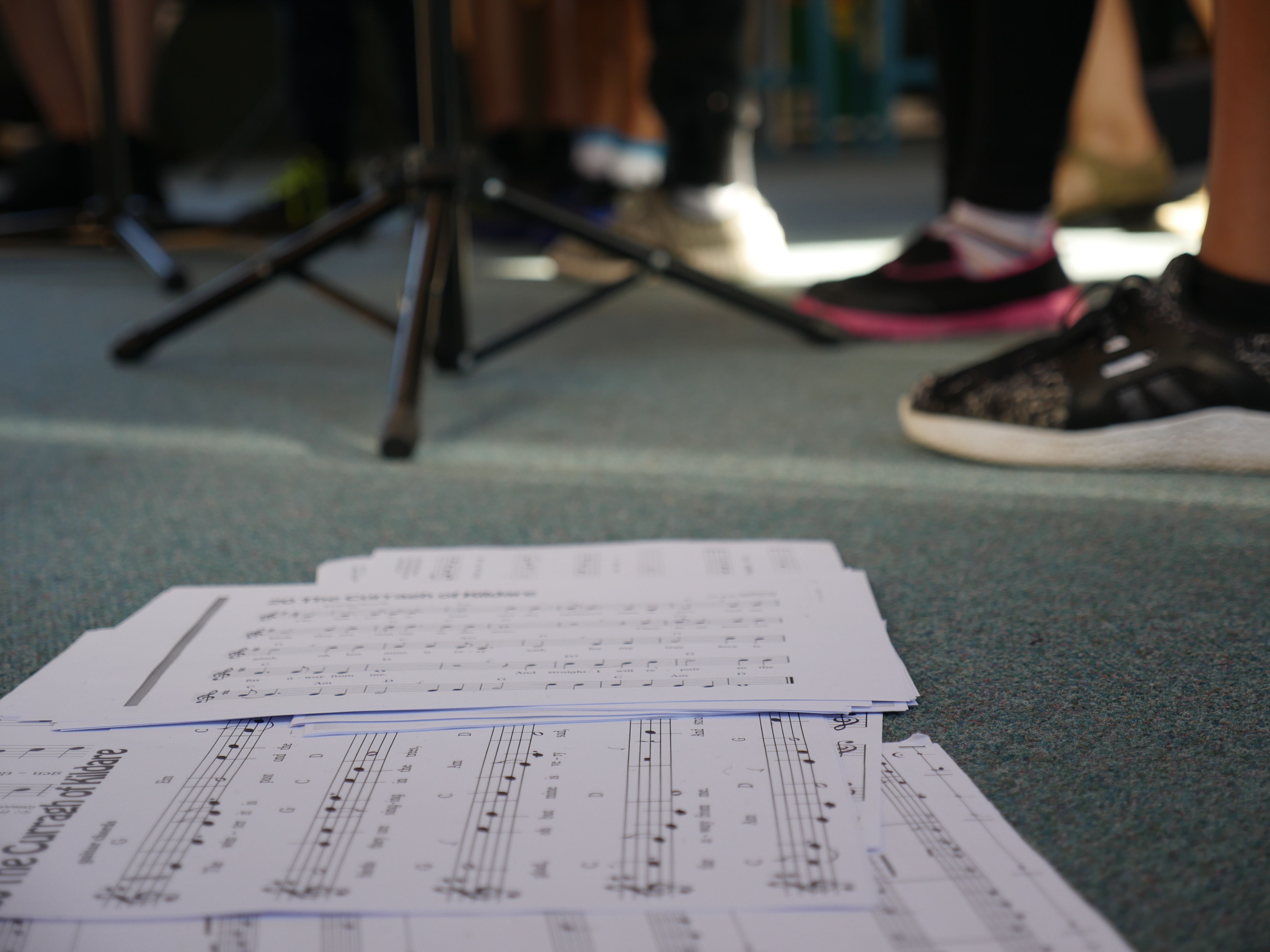
    I am currently working on a research project that looks at the social impacts of Arohanui StringsPorirua Soundscapes, and Virtuoso Strings. These groups provide free, Sistema-inspired orchestral music education programmes in low decile schools in Hutt Valley and Porirua. This project is funded by the Royal Society of New Zealand’s Marsden Fund.

    Music colour
    Photo: Lorena Gibson

    El Sistema is a Venezuelan music and social development initiative that began in 1975 and is today one of the world’s largest and most famous orchestral music education programmes. Sistema-inspired programmes operate in over 60 countries worldwide, including Aotearoa New Zealand, providing musical and social opportunities to underprivileged children with the aim of transforming their lives, their families’ lives, and their wider communities (Booth & Turnstall 2014, 2016; Sistema Global: Friends of El Sistema Worldwide 2015).

    In the last decade, scholars have paid increasing attention to how Sistema-inspired programmes operate in different cultural contexts, reporting positive outcomes in musical and educational attainment, development of children’s personal and social skills (including discipline, positive attitudes towards school, and raised aspirations) and family engagement (Creech et al 2016; Osborne et al 2015; Trinick & McNaughton 2013). Fewer studies have focused on the wider social development aims of Sistema-inspired programmes, however, such as community wellbeing and socioeconomic impacts (Allan 2010; Burns & Bewick 2015; Uy 2012), and a growing number of researchers are critiquing orchestral music education programmes for promoting middle-class Western ideologies and for unintentionally reproducing rather than challenging structural inequalities (e.g., Baker 2014; Bull 2016). This is where my project comes in. I want to look beyond educational achievement to learn more about the social effects that Arohanui Strings, Virtuoso Strings, and Porirua Soundscapes have on the young people who participate in music classes, as well as their families and their wider communities. My aim is to understand how these groups transform young people’s lives through music.

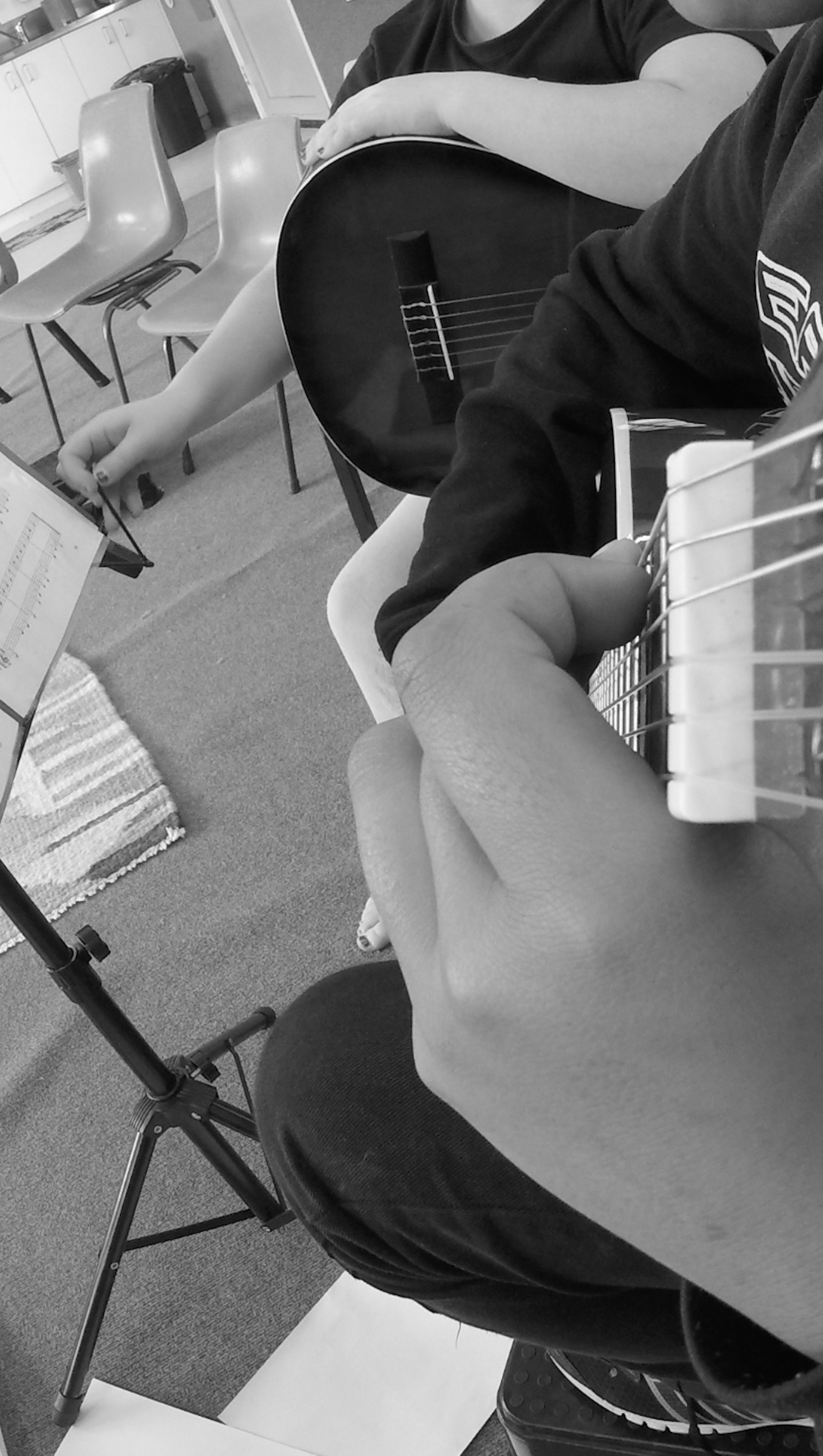
    GuitarGoPro b&w
    Photo: Lorena Gibson

    I am using a range of ethnographic methods in this project, including interviews, participant-observation (attending rehearsals, concerts, holiday programmes, and other events), photography, and participatory video. This involves inviting some of the young people involved in these organisations to use video cameras to document their experiences, and collaborate with me on making a short ethnographic film – for example, by working with me to decide what should be in the film, shooting footage for it, and advising me during the editing process.

    As well as making an ethnographic film showing how young people experience the relationship between music and social change, I will produce reports for Arohanui Strings, Virtuoso Strings, and Porirua Soundscapes. I will write academic journal articles and book chapters, and give a public talk at the end of the project (early 2020), and will upload published material here to this blog.

    This research has been approved by the Victoria University of Wellington Human Ethics Committee, application reference 24293. If you have any questions about it, or are interested in becoming involved, please contact me.
     

    References

    Allan, J. 2010. Arts and the inclusive imagination: Socially engaged arts practices and Sistema Scotland. Journal of Social Inclusion, 1(2): 111-122.

    Baker, G. 2014. El Sistema: Orchestrating Venezuela’s youth. New York: Oxford University Press.

    Booth, E., & Tunstall, T. 2014. Five encounters with “El Sistema” International: A Venezuelan marvel becomes a global movement. Teaching Artist Journal, 12(2): 69-81.

    Booth, E., & Tunstall, T. 2016. Playing for Their Lives: The Global El Sistema Movement for Social Change Through Music. New York: W. W. Norton & Company.

    Bull, A. 2016. El Sistema as a bourgeois social project: Class, gender, and Victorian values. Action, Criticism, and Theory for Music Education, 15(1), 120-53.

    Burns, S., & Bewick, P. 2015. In Harmony Liverpool Year 5 Evaluation: Health and Well- Being Report. https://issuu.com/liverpoolphilharmonic/docs/in_harmony_liverpool_year_5_evaluat

    Creech, A., Gonzales-Moreno, P., Lorenzino, L., Waitman, G., Bates, L., Swan, A., de Jesus Carillo Mendez, R., Hernandes, D.N.C., & Gonzales, P. C. 2016. El Sistema and Sistema-inspired programmes: A literature review of research, evaluation, and critical debates (2nd ed.). San Diego, California: Sistema Global.

    Osborne, M. S., McPherson, G. E., Faulkner, R., Davidson, J. W., & Barrett, M. S. 2015. Exploring the academic and psychosocial impact of El Sistema-inspired music programs within two low socio-economic schools. Music Education Research, 18(2), 156-175.

    Trinick, Robyn and Stuart McNaughton. 2013. Independent evaluation of the music learning outcomes in the Sistema Aotearoa Programme. Report prepared for Auckland Philharmonia Orchestra. Faculty of Education, the University of Auckland.

    Uy, M. S. 2012. Venezuela’s national music education program El Sistema: Its interactions with society and its participants’ engagement in praxis. Music and Arts in Action, 4(1): 5-2.


    Doing fieldwork with kids: Part I

    Recently I started a new research project looking at the social impacts of three Sistema-inspired orchestral music education programmes operating in low decile schools in the Wellington region, where I live. El Sistema is a Venezuelan music and social development initiative that began in 1975 and is today one of the world’s largest and most famous orchestral music education programmes. Sistema-inspired programmes operate in over 60 countries and there are at least six here in New Zealand, including Auckland-based Sistema Aotearoa. My new project involves working with kids: those involved in the orchestral programmes, and my own. In this post I reflect on what it’s like to do fieldwork with my kids in tow, and in the next I’ll discuss how I plan to work with the children in these programmes.

    It took me a good couple of years after finishing my PhD to start a new major research project. There were a few reasons for this. Two weeks after submitting my PhD I started working as a lecturer on a series of short-term contracts which meant constantly developing and teaching new courses. I needed to publish from my dissertation so I could secure a permanent academic position – something that is extraordinarily difficult as an adjunct, as many blogs, news articles and #quitlit posts on social media have pointed out. I had my daughter in 2012. And I needed some space to think about what I wanted to work on for the foreseeable future. In 2013 I was employed on a 3-year, part-time contract, meaning I could access university research funding not available to those on short-term contracts. This, combined with the fact that you need to be research-active with a track record of obtaining funding in order to compete for academic jobs, meant it was a good time to develop a new research project.

    When I started my PhD I had not yet met my husband and children were not on my horizon, so everything and anything seemed possible. Now I had two other people to think about in deciding where, how, and what I wanted to research – in that order. I wanted to do ethnographic fieldwork in Wellington and continue my interest in development and social justice. Basing my new project in Wellington was also a practical decision: I could take my daughter with me, I wouldn’t need to be away from home for extended periods of time, and I could get started without the security of funding or a permanent job. Coming up with a feasible project was more difficult, but a serendipitous sequence of events led me to Sistema Aotearoa and eventually the charitable organisations that run Sistema-inspired orchestral music programmes in Hutt Valley and Porirua.

    I was pregnant with my second child by the time I established relationships with the organisations, developed a research proposal and obtained funding, and received ethics approval to begin the research. Ethnographic fieldwork was relatively straightforward to begin with as I could take my music-loving daughter and composer/conductor/musician husband along to interviews and performances. Things became a bit tricker after our son was born last year.

    2015-09-26 08.45.32
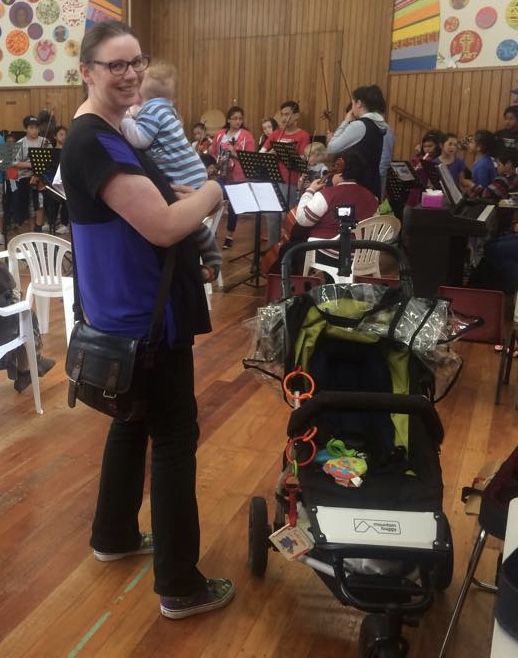
    Part of my field-and-carework kit

    For a start, my fieldwork kit expanded significantly from a pen, notebook, iPad and camera to include nappy bag, frontpack, and buggy as well as preschooler snacks and activities. I didn’t always have my daughter with me but my son was now a permanent attachment, meaning I relied heavily on family and research assistants for help. He still breastfeeds frequently at night and at the moment my fieldwork doesn’t extend to evening rehearsals as it is just too difficult to get away after the dinner-bath-bed routine. I do go to some evening and weekend performances, usually with one or both kids in tow, and my husband or mother-in-law (also a musician).

    Combining fieldwork with carework is not easy. I no longer write notes in the field while my kids are with me, instead relying on my memory, what Simon Ottenberg terms ‘headnotes’ (in the 1990 book Fieldnotes: The Makings of Anthropology edited by Roger Sanjek), and my GoPro camera. I miss things when I’m breastfeeding or changing nappies or leaving the room with a screaming baby or taking a preschooler who’s had enough somewhere else to play. (I have a keen recollection of my then 3-year-old daughter standing up during the middle of a concert and loudly announcing, “That’s enough, everyone wants to go home now.”) My kids miss me when I pay attention to the person I’m interviewing or spend an afternoon at music lessons without them. I often don’t get time to write up my fieldnotes in Evernote at the end of the day, and I definitely don’t have the same amount of time or headspace available to just think.

    Despite the difficulties, there are a lot of things I enjoy about combining fieldwork with carework. I like my children being able to see and participate in what I do and love watching their interest in music grow. I get a different perspective when sitting on the floor with my son. My daughter often makes interesting observations about things that I hadn’t noticed, and I value being able to discuss the musical aspects of performances with my husband and mother-in-law. I also appreciate the connections I can make with the children I’m working with, who invariably ask “whose mother are you?” upon meeting me, and also with their parents.

    Doing fieldwork with children in tow is not new; a number of anthropologists and geographers have offered useful insights into how one’s children can shape the research process. Kelly Dombroski’s excellent blog post on carework in fieldwork discusses some recent publications on this topic (including her own). However I have not yet come across much work that reflects on fieldwork at home with children. Even this “Family in the Field” survey of anthropologists undertaking fieldwork with their children assumes that ‘the field’ is somewhere away from home.

    Do you do ethnographic fieldwork with your kids at locations close to your home? Do you know of people who have written about this? I would love to hear of your experiences!

    Version 3
    At a concert with my 5 month old (note the buggy doubling as a tripod)


    Anthropology theses published in Aotearoa New Zealand in 2014

    Following on from my post last year, here is a list of theses (Masters and PhD) published in anthropology departments in Aotearoa New Zealand in 2014. My list includes all major universities except for Auckland University of Technology, not because AUT doesn’t offer anthropology (it does, in the School of Social Sciences and Public Policy) but because it takes an interdisciplinary approach and I couldn’t tell which of its theses were more or less ‘anthropological.’

    I compiled this list by searching the New Zealand National Union Catalogue of the National Library of New Zealand, which holds masters theses and doctoral dissertations awarded by New Zealand universities. I also searched individual university library catalogues and online research commons. I used the keywords “anthropology” and “thesis” in my search. Some catalogues were more difficult to navigate than others and I had restricted access to several resources, so my apologies to those whose names I have missed. Please comment below if you have a thesis to add to this list or correction I need to make.

    Continue reading

    Rethinking Responsibility

    The programme is now out for this weekend’s conference, Competing Responsibilities: The politics and ethics of responsibility in contemporary life. I’m excited to hear keynote speakers Nikolas Rose and Cris Shore, of course, but I am also looking forward to hearing how other presenters are rethinking responsibility and responsibilization as theoretical and analytical concepts. SavageMinds.org recently featured an interview with conference organisers Catherine Trundle and Susanna Trnka which nicely introduces the conference theme.

    I was inspired by the conference theme and have developed the paper below (based on my PhD research) to focus on how grassroots organisations become responsibilized in the absence of effective state interventions in urban poor areas.

    TITLE:
    Responsibilizing grassroots organisations in “forgotten places” in Howrah, West Bengal, India.

    ABSTRACT:
    In 1991 the Government of India implemented widespread economic liberalisation policies which, as well as contributing to India’s recent economic rise to global significance, had important and uneven effects on various social groups within India. Despite official reports of declining poverty in India, neoliberal ideas and policies have not improved the lives of those living in poverty – many of whom are Muslim – in bastis in Howrah, West Bengal. This paper argues that Howrah’s bastis are “forgotten places,” historically and politically constructed enclaves that are neglected, but nevertheless deeply inhabited, by the state. In these bastis, services that are the responsibility of the state – such as access to education – are not adequately provided for, leaving a gap that NGOs and grassroots organisations try to fill. This paper provides an ethnographic account of what happens in such “forgotten places” by describing the efforts of Howrah Pilot Project, an organisation that seeks to address this gap by running a grassroots-level, nonformal school in one of Howrah’s bastis. Processes of ‘active forgetting’ serve to responsibilize such organisations, but their practices need to be augmented by a responsive state in order to achieve meaningful, long-term, beneficial change.

    Anthropology theses published in Aotearoa New Zealand in 2013

    Ever wondered what kind of topics graduate students in anthropology work on in ‘the antipodes’ (a term I’ve often heard used to describe where I’m from)? The following is a list of theses (Masters and PhD) published in anthropology departments in Aotearoa New Zealand in 2013.

    I compiled the list by searching the New Zealand National Union Catalogue of the National Library of New Zealand, which holds masters theses and doctoral dissertations awarded by New Zealand universities as well as individual university library catalogues. I used the keywords “anthropology” and “thesis” in my search. Some catalogues were more difficult to navigate than others and I had restricted access to several resources, so my apologies to those whose names I have missed.

    The theses are listed in alphabetical order according to the surname of the graduate. Congratulations to everyone to everyone who received degrees!

    The Political Economy of Monumental Architecture at Nan Madol, Pohnpei, Federated States of Micronesia, by Helen Alycia Alderson.
    Department of Anthropology and Archaeology, University of Otago
    Advisor: Mark McCoy
    Degree: Master of Arts

    Fetal alcohol spectrum disorder diagnosis and intervention: An investigation of professional practice in New Zealand, by Kerryn Bagley.
    Department of Anthropology and Archaeology, University of Otago
    Advisors: Rugh Fitzgerald and Chrystal Jaye
    Degree: Doctor of Philosophy

    The Sweet Potato Factory – An Archaeological Investigation of the Pouerua Cultivation Landscape, by Alexander Campbell Bell.
    Department of Anthropology and Archaeology, University of Otago
    Advisor: Ian Barber
    Degree: Master of Arts

    The Disrupted and Realigned Self: Exploring the Narratives of New Zealanders with Chronic Fatigue Syndrome/Myalgic Encephalomyelitis, by Lara Joyce Milka Bell.
    Cultural Anthropology, Victoria University of Wellington
    Advisors: Catherine Trundle and Rhonda Shaw
    Degree: Master of Arts

    Tombs and trade: strontium and mobility at ed-Dur (U.A.E.), by Augusta Violet Bunting.
    Anthropology, University of Auckland
    Degree: MA Biological Anthropology

    Bodies in context: a comparative study of early childhood education in New Zealand and Japan, by Rachael Sarah Burke.
    Social Anthropology, Massey University
    Advisors: Graeme MacRae (Massey) and Judith Duncan (Canterbury)
    Degree: Doctor of Philosophy

    Bronze Age nomadic pastoralism on the Mongolian Steppe, by Brittany Rose Carroll.
    Anthropology, University of Auckland
    Degree: Master of Arts

    Time of Transition: Patterns of Obsidian Exchange and Utilization during the Lapita and Post-Lapita Periods on Watom Island, Papua New Guinea, by Yi-lin Chen.
    Department of Anthropology and Archaeology, University of Otago
    Advisor: Glenn Summerhayes
    Degree: Master of Arts

    Glimpses of Eternity: Sampled Mormon Understandings of Disability, Genetic Testing, and Reproductive Choice in New Zealand, by Kristin Clift.
    Department of Anthropology and Archaeology, University of Otago
    Advisor: Ruth Fitzgerald
    Degree: Master of Arts

    Medicating Miners: The Historical Archaeology of the St Bathans Cottage Hospital, by Jessie Garland.
    Department of Anthropology and Archaeology, University of Otago
    Advisor: Ian Smith
    Degree: Master of Arts

    ‘Wrought into being’: An archaeological examination of colonial ideology in Wellington, 1840-1865, by Rose Caroline Geary Nichol.
    Department of Anthropology and Archaeology, University of Otago
    Advisor: Ian Smith
    Degree: Master of Arts

    Dental pathology profile of pre-European Maori and Moriori, by Amanda George.
    Department of Anthropology and Archaeology, University of Otago
    Advisors: Richard Walter and Jules Kieser
    Degree: Doctor of Philosophy

    Argonauts of Aotearoa: voyages of alternative ageing via the movanner archipelago, by Kim Green.
    Social Anthropology, Massey University
    Advisors: Graeme MacRae and Kathryn Rountree
    Degree: Master of Arts

    What’s Cooking? An Archaeological Residue Analysis of Ceramics from Thailand, by Cathleen Hauman.
    Department of Anthropology and Archaeology, University of Otago
    Advisors: Charles Higham and Russell Frew
    Degree: Master of Arts

    Game Balance: Designed structure and consumer agency in an online game, by Elizabeth Haynes
    Cultural Anthropology, Victoria University of Wellington
    Advisor: Catherine Trundle
    Degree: Master of Arts

    Himalayan journeys: a mobile ethnography and philosophical anthropology, by Christopher A. Howard.
    Social Anthropology, Massey University
    Advisors: Kathryn Rountree and Graeme MacRae
    Degree: Doctor of Philosophy

    Buying fair: the moral assemblage of Trade Aid and its supporters / Corinna Frances Howland.
    Anthropology, University of Auckland
    Degree: Master of Arts

    “Still at nature’s mercy”: human-environmental relations after the Christchurch earthquakes, by Heidi Elisabet Käkelä.
    Anthropology, University of Auckland
    Degree: Master of Arts

    “Nourishing ourselves and helping the planet”: WWOOF, Environmentalism and Ecotopia: Alternative Social Practices between Ideal and Reality, by Elisabeth Kosnik.
    Cultural Anthropology, Victoria University of Wellington
    Advisors: Brigitte Bönisch-Brednich and Catherine Trundle
    Degree: Doctor of Philosophy

    Assessing the temporal foundations of supra-regional models for early to mid-Holocene climate-cultural change, northeast Africa, by  Natasha Phillips.
    Anthropology, University of Auckland
    Degree: Master of Arts

    Shooting and friendship over Japanese prisoners of war: differences between Featherston, New Zealand and Cowra, Australia in Japanese connections, by Yasuhiro Ota.
    Social Anthropology, Massey University
    Advisor: Graeme MacRae
    Degree: Master of Arts

    Foreign seasonal workers in New Zealand horticulture: an ethnographic account of the nexus of labour and immigration policies and employment practices, by Jana Prochazkova.
    Department of Anthropology and Archaeology, University of Otago
    Advisors: Jacqueline Leckie and Martin Tolich
    Degree: Doctor of Philosophy

    Relieve me of the bondage of self: addiction practitioners from three treatment centres in New Zealand discuss the use of community as a method of healing the self, by Derek Ross Quigley.
    Social Anthropology, Massey University
    Advisors: Eleanor Rimoldi and Kathryn Rountree
    Degree: Master of Philosophy

    The politics of influence : an anthropological analysis of collective political action in contemporary democracy, by Kathryn Scott.
    Anthropology, University of Auckland
    Advisors: Julie Park and Cris Shore
    Degree: Doctor of Philosophy

    Soldiers’ Foodways: Historical Archaeology of Military Comestibles in the Waikato Campaign of the New Zealand Wars, by Alexandra Lee Simmons.
    Department of Anthropology and Archaeology, University of Otago
    Advisors: Ian Smith and Helen Leach
    Degree: Doctor of Philosophy

    Neighbours and Social Capital in the wake of the Christchurch Earthquakes, by Kirsten Stallard.
    Department of Anthropology and Archaeology, University of Otago
    Advisor: Gregory Edward Rawlings
    Degree: Master of Arts

    Narratives of Incorporation: An Anthropological Analysis of Same-Sex Civil Unions in New Zealand, by Dionne Steven.
    Cultural Anthropology, Victoria University of Wellington
    Advisors: Brigitte Bönisch-Brednich and Catherine Trundle
    Degree: Doctor of Philosophy

    Understanding the culturally modified tree record and the socio-economy of the Weipa mission in Cape York, Australia, by Eleanor Jeneen Sturrock.
    Anthropology, University of Auckland
    Degree: Master of Arts

    Cheese Machines and Cellos: Technical Craftsmen and Craft Technicians, by Gwenda Dorothy Wanigasekera.
    Anthropology Programme, the University of Waikato
    Advisors: Michael Goldsmith and Tom Ryan
    Degree: Doctor of Philosophy

    Between Gifts and Commodities: “Op Shops” in Dunedin, New Zealand, by Valerie Jane Wilson.
    Department of Anthropology and Archaeology, University of Otago
    Advisor: Jacqueline Valerie Leckie
    Degree: Master of Arts

    Artefacts and Community Transformations: A Material Culture Study of Nineteenth Century North Dunedin, by Naomi Woods.
    Department of Anthropology and Archaeology, University of Otago
    Advisor: Ian Smith
    Degree: Master of Arts

    AnthroPod: The SCA Podcast

    Seems I’m not the only one who likes the name anthropod!* The Society for Cultural Anthropology has recently launched a podcast series dedicated to interviewing cultural anthropologists about their work and experiences in the field.

    The two podcasts available so far feature interviews with Michael Fisch (episode 1) about his research on commuter train suicides in Tokyo, and Richard Handler (episode 2) about how he helped to found the graduate Global Development Studies programme at the University of Virginia. Both Fisch and Handler have recently published articles on these topics in the journal Cultural Anthropology, and the podcast links to those articles (one is available through open access, the other is behind a paywall).

    I was pleased to discover that the interviews don’t simply repeat what is in the articles; instead they provide the anthropologists with an opportunity to talk about their work in a more informal manner. I enjoyed hearing them enthuse about their work, discuss the challenges of fieldwork, and talk about how they developed their research projects and theoretical frameworks. Prof. Handler’s interview in particular was thought-provoking because of my own research interests in development, and like him I have found a lot of anthropology students are keen to work in the field of development.

    The SCA promises more podcasts featuring interviews like this as well as shorter snippets explaining what anthropology is and what anthropologists do. If these first two are anything to go by, I will be a regular subscriber.

    * anthropod: a term sometimes used in science fiction to describe humanoid alien beings. (That’s where I came across it, at any rate!)