Ethnographic writing intensive: Five activities for the fieldwork-to-writing transition

Recently I have been thinking about how I learnt to transition from fieldwork to writing. Like many graduate students, mid-way through my thesis research I found myself with a stack of notebooks and detailed fieldnotes, interview transcripts, and hundreds of photos (among other things), but I wasn’t sure how to transform this material into ethnographic writing. The shift from gathering data to crafting compelling stories requires a different set of skills that aren’t always explicitly taught in methods courses.

Over the years, as I have supervised graduate students and taught courses on ethnographic methods, I have noticed others struggling with this fieldwork-to-writing transition. In this post I share five activities I have developed to help with that transition. The activities are modelled after the best writing course I have ever done (“Unstuck: The Art of Productivity” with Kel Weinhold from The Professor Is In) and draw on prompts in Kirin Narayan’s excellent book Alive in the Writing: Crafting Ethnography in the Company of Chekhov (2012) as well as my lecture notes from courses I have taught (including ANTH 312 Creative Ethnographic Practices).

These activities form an ethnographic writing intensive designed to strengthen your ethnographic writing practice. They address common challenges I see students facing: how to separate your thoughts from your writing; how to structure a piece of work; how to start with participant perspectives, how to write yourself into the narrative, how to write an ethnographic story.


Activity One: Investigate your thoughts with The Professor Is In

I recommend starting here, with a blog post by writing coach Kel Weinhold from The Professor Is In, because I have found it helpful in dealing with negative thoughts (hello imposter syndrome, my old friend!) in my own writing. This approach has helped me separate my thoughts from my writing process.

Tasks:

  • Read this blog post: https://theprofessorisin.com/2022/06/07/just-one-thing-investigate-your-thoughts/
  • The blog post suggests that writers sometimes have thoughts that feel completely true but actually interfere with making progress. As Kel writes, “The issue is not whether or not we have unhelpful thoughts; the issue is what we do with thoughts” (Weinhold, 2022)
  • See if any of the examples in the post resonate with your own writing experiences
  • If so, work through the investigative process in Kel’s blog post

Reflective question:

What, if anything, did you find useful in this approach that you might carry forward in your own writing practice?


Activity Two: Reverse outline a model piece of writing

I first learnt about reverse outlines through “Unstuck” and since then have recommended doing them to just about all of my graduate students.

For this activity, you are going to create a reverse outline of a model of the kind of writing you are currently working on (e.g. a MA thesis chapter, a journal article). This is a technique I regularly use myself. Usually people create reverse outlines of their own work, but I like to do it with examples of other peoples’ work so I can get a feel for how the piece of writing is structured and what each paragraph does for their argument and overall flow of the writing.

Tasks:

  • Read this blog post on reverse outlines: https://writing.wisc.edu/handbook/reverseoutlines/
  • Read another blog post on reverse outlines: https://owl.purdue.edu/owl/general_writing/the_writing_process/reverse_outlining.html
  • Choose a model piece of writing to work with (e.g. a chapter from a thesis your supervisor recommends, or an article from the journal you want to write for)
  • Sit down and read the piece from start to finish. Just read it; don’t take notes or do any highlighting
  • Read the piece again with a pen. Number each paragraph as you re-read
  • On a fresh piece of paper, write down the number of each paragraph and a sentence or phrase that describes what the author is accomplishing in that paragraph (e.g. this paragraph introduces and defines key concepts; explains the purpose of the chapter; lists the central research questions; situates the chapter in relation to other literature; etc)
  • Optional: add a star next to the paragraph numbers that you think are doing especially important work, or that you particularly like
  • Then, look at a draft you are currently working on to see where you might use elements of the model piece in your own work (e.g. ‘I need to have a paragraph that explains how this chapter contributes to my overall thesis argument’)

Reflective question:

What was useful about this activity? Might you use the reverse outline process on your own writing?


Activity Three: Starting on the ground

“The term “ethnography” has its roots in the Greek words ethnos (folk, the people) and grapho (to write). Ethnography is to write about people, society, and/or culture, but it is much more than writing. It is also a method and a theory. As a method, ethnography is an embodied, empirical, and experiential field-based way of knowing centered around participant observation. Ethnographic research requires participation, not just observation. It is to participate in rather than just observe the daily life, logics, rhythms, and contradictions of a cultural group or society. As such, it requires discipline and commitment beyond what is visible to someone not trained in ethnographic methods. As a theory, ethnography is to start on the ground, with the concepts that ground people’s lives, worldviews, actions, and words in particular ways to that community.”

McGranahan, Carole. 2018. “Ethnography.” In The International Encyclopedia of Anthropology, edited by H. Callan, Wiley. https://doi.org/10.1002/9781118924396.wbiea2262

This activity takes its cue from the first lecture I give in my Creative Ethnographic Practices class. In it, I discuss Carole McGranahan’s point that theory, in ethnography, means to start “on the ground”, with what your participants have to say. Rather than starting with theories developed by others, ethnographic writing tends to ask: what’s going on here? What are my participants telling me about how their world works?

Tasks:

  • Choose a paragraph from a draft you are working on
  • What does the paragraph start with? If it starts with someone else’s theory, can you see a way to rewrite it so your participant’s words and explanations guide your analysis?
  • Note that not every single paragraph needs to do this; the activity prompts you to show how you are building understanding inductively, starting “on the ground” with what your participants said

Reflective question:

What did you notice about the difference between starting with other people’s theories versus starting with participant explanations? How might this approach change the way you build arguments in your writing?


Activity Four: Writing yourself into the text

This activity is drawn from two sources. The first is a lecture I give on autoethnography (a methodology many of our students are drawn to), where I discuss Leon Anderson’s argument that analytic autoethnography requires “narrative visibility of the researcher’s self” (2006, 378).[1] Autoethnographic writing requires you to be visible as a researcher while being in conversation with your participants. Ethnographic writing, too, often includes the presence of the researcher to show how their knowledge was produced. Since dialogue can be a generative way of illustrating key insights from your research while showing the relational nature of knowledge-production, the second source I have drawn on is Kirin Narayan’s chapter “Voice” from Alive in the Writing. This chapter has an excellent discussion of how to “build texts from conversations” (page 69 Kindle edition), and in my course on Creative Ethnographic Methods I ended each lecture with in-class writing prompts (like the ones below) based on Narayan’s work.

[1] Anderson, Leon. 2006. “Analytic Autoethnography.” Journal of Contemporary Ethnography 35 (4): 373–95.

Tasks:

  • Read “Chapter Four: Voice” from Narayan’s Alive in the Writing
  • Writing activity 1: Locate a quote from one of your participants on the issue you’re writing about and experiment with working just a line or two into an introduction (adapted from the prompt on page 73)
  • Writing activity 2: Write an extended conversation in which one of your participants explains a concept to you. Include your questions in the dialogue (adapted from the prompt on page 75)
  • Writing activity 3: Revisit one of your interview transcriptions, using different colour pens to highlight (a) the main questions you asked, (b) your subsidiary questions, and (c) your participant’s answers (adapted from the prompt on page 77)
  • Writing activity 4: Draw on the interview transcript you looked at for the previous activity to create a 2-page dialogue between you and a participant that reveals information or insights central to your project. Pay attention to the textures, cadences, and intonations of voices, including your own (adapted from the prompt on page 92)

Reflective question:

After experimenting with these different ways of writing yourself in to your work via dialogue, what did you notice about how the presence of your questions and responses changes the way insights emerge in your writing? How might dialogue work differently than summary or analysis for revealing what you learned in interviews?


Activity Five: Ethnographic storytelling

“Focusing on stories that have been co-created enables me to work on the ethnographic narrative and its process of coming into life through storytelling. In starting with the creation of ethnographic stories and story lines I am following an argument by Soyini D. Madison; she has criticised the tendency to avoid transparency in oneʼs own ethnographic storytelling techniques by hiding behind the writing of others and showing off (with the theory of others) in order to give more weight to oneʼs own ethnography while hiding possible flaws. She observes that rather than taking guidance from and trusting the stories, instead “the researcher becomes so enamored with […] impressing colleagues that honoring the narrative becomes less important than acrobatics of abstraction and theoretical word play” (Madison 2014, 394)”.

Bönisch-Brednich, Brigitte. 2018. “Writing the Ethnographic Story: Constructing Narrative Out of Narratives.” Fabula 59 (1-2): 8–26. Page 12.

This activity is based on a lecture I give on ethnographic storytelling. I begin that lecture by talking about a blog post Carole McGranahan wrote in 2015, where she writes: “What is defective is how we miss the power of stories and storytellers even as well tell them. We tell stories to get to the point, to make our points. We miss that the stories are the point” (my emphasis added). McGranahan puts forward an argument similar to the one that Madison makes in the quote from Bönisch-Brednich’s article cited above (which I also discuss in that lecture): that we use our participant’s voices to make our own theoretical arguments (often drawing on the theory of others) rather than letting their stories carry the weight of ethnographic insight.

Tasks:

  • Choose a story that one of your participants shared with you that you found especially memorable (perhaps one you are working with in a current piece of writing). You will work with this story in three ways
  • Writing activity 1: write the story as if you are reporting it for a newspaper, using the journalistic who-what-when-where-why-how questions and describing the basic sequence of events
  • Writing activity 2: write the story as your participant might (see the ethnographic vignette that Bönisch-Brednich shares on pages 12-13 of her article for an example)
  • Writing activity 3: Following Bönisch-Brednich’s article or McGranahan’s blog post, write the story for your draft, discussing what it shows about broader patterns in your research and connecting it with relevant theory. This is how it becomes ethnographic storytelling

Reflective question:

After writing the same story three different ways, what did you notice about how each approach revealed different aspects of the experience? How did writing activity 3 differ from simply adding analysis to writing activity 1?


I designed these activities with individual work in mind, but they might also be useful starting points for a ‘shut up and write‘ session with peers. If you try one or more of them, please let me know your thoughts in the comments – I would love to hear from you!

Further reflections on writing ethnographic fieldnotes

The most popular post on my blog describes the fieldnote template I developed during the early stages of my PhD research with community-based NGOs running educational and economic development initiatives in Kolkata (India) and Lae (Papua New Guinea). This fieldnote template has made its way into other blog posts about ethnographic research, textbooks and articles, course outlines, and academic commons. Last year my colleague Grant Jun Otsuki assigned it as a reading for his first year Cultural Anthropology class at Te Herenga Waka-Victoria University of Wellington as a way of helping students prepare for an assignment that involved doing fieldwork, writing fieldnotes, and turning those fieldnotes into a piece of anthropological writing. Grant invited me to come and speak to the class, and that experience has prompted me to write some further reflections on writing ethnographic fieldnotes as a disabled, neurodivergent anthropologist.

In my guest lecture I spoke about why anthropologists keep fieldnotes, what my fieldnotes consist of (handwritten notebooks, photographs, maps, drawings, emails, ticket stubs and other ephemera, voice recordings, notes jotted in an app on my phone, a personal diary, and of course the hundreds of electronic documents generated with my fieldnote template), and my relationship with my fieldnotes, including how I draw on fieldnotes alongside headnotes (Ottenberg, 1990) when I write. I also discussed how ethnographic fieldwork is an all-encompassing activity that involves your body, mind, senses, and memories, and how my fieldnote template offers me a way to document my experiences and begin identifying what and how I “know” about my topic. As part of that, I described some of the strategies I use to manage my energy levels and wellbeing during fieldwork. In India and Papua New Guinea this included ensuring I had access to my medication at all times, packing my own food, wearing headphones, trying to avoid situations that would trigger migraines, and scheduling rest days in between fieldwork days so I could process sights, sounds, smells, and social interactions.

What I didn’t say during my guest lecture was how I have largely developed these strategies on my own. When I began my first major research project in the early 2000s, there were no guides on how to do ethnographic fieldwork as a disabled neurodivergent anthropologist. Neurodiversity, disability, and chronic illness were subjects of anthropological studies that I read as a student, but I don’t recall reading anything written by openly neurodivergent, disabled, or chronically ill anthropologists. We also did not use the terms “neurodivergent” or “disabled” in New Zealand in the early 2000s to describe people like me, who have been diagnosed with various mental health disorders (not all of which I am comfortable disclosing) and medical conditions like chronic migraine and endometriosis (which I am comfortable to share publicly). And I did not write this part of myself into my academic work. Indeed, in one instance I was actively discouraged from writing about how depression and anxiety affected my fieldwork by a well-meaning colleague who worried about how such a disclosure would negatively affect (a) how the quality of my work would be perceived, and (b) my chances of future employment in academia. “You can do that once you’ve finished your PhD and got a permanent job,” was the advice. Now, 13 years on from finishing the PhD and 9 years after securing a permanent job, I am still ambivalent about bringing my neurodivergence into my writing, research, and teaching. All anthropology is filtered, as Amelia Frank-Vitale (2022) points out, but I think there is still considerable stigma against neurodivergent filters. However, as Cinzia Greco (2022) asks,

… if ethnography and participant observation represent core anthropological methods, through which reality is filtered and turned into knowledge, what does it mean to observe, analyze, and conduct fieldwork as a neurodivergent subject? How can variation in how we see, hear, and perceive the world influence ethnographic practice?

These are important questions and I am heartened to see growing conversations about neurodivergence, abelism, and anthropology in academic circles (including, but by no means limited to, Durban 2022; Friedner with Kasnitz and Wool 2018; Gibson 2018; Kinsell 2022; Kasnitz 2020; Morgendorff 2023; Radher 2018; Starn 2022). If you have reading or researcher recommendations, please feel free to comment below or get in touch.

References cited:

Durban, Erin L. 2022. “Anthropology and Ableism.” American Anthropologist 124 (1): 8–20.

Greco, Cinzia. 2022. “Divergent Ethnography: Conducting Fieldwork as an Autistic Anthropologist.” Member Voices, Fieldsights, May 26. https://culanth.org/fieldsights/divergent-ethnography-conducting-fieldwork-as-an-autistic-anthropologist

Frank-Vitale, Amelia. 2022. “Writer’s Block.” In “Taking Note: Complexities and Ambiguities in Writing Ethnographic Fieldnotes,” edited by Magdalena Zegarra Chiappori and Verónica Sousa, American Ethnologist, 26 August. https://americanethnologist.org/features/collections/taking-note-complexities-and-ambiguities-in-writing-ethnographic-fieldnotes/writers-block

Friedner, Michele, with Devva Kasnitz and Zoë Wool. 2018. ‘What I Wish I Knew about Anthropology and Disability: Notes toward a more enabling anthropology’, Anthrodendum, 10 January. https://anthrodendum.org/2018/01/10/what-i-wish-i-knew-about-anthropology-and-disability-notes-toward-a-more-enabling-anthropology/ 

Gibson, Hannah. 2018. “Access denied: the dark side of prestige.” Chronically Academic https://chronicallyacademic.blogspot.com/2018/01/access-denied-dark-side-of-prestige.html

Kasnitz, Devva. 2020. “The Politics of Disability Performativity.” Current Anthropology 61 (S21): S16–25.

Kinsell, Hannah. 2022. “Am I an Anthropologist if… I am (dis)abled?” Anthways https://sites.gold.ac.uk/anthways/am-i-an-anthropologist-if-2022/am-i-an-anthropologist-if-i-am-disabled/

Mogendorff, Karen. 2023. “Countering Ableism in Knowledge Production. Empowerment of Subaltern People and Reproduction of Epistemic Hierarchies.” Swiss Journal of Sociocultural Anthropology 28, 41–60.

Ottenberg, Simon. 1990. “Thirty Years of Fieldnotes: Changing Relationships to the Text.” In Fieldnotes: The Makings of Anthropology, edited by Roger Sanjek, 139–60. New York: Cornell University Press.

Radher, Micha. 2018. “Ethnographic Ableism: Structural Silencing of Physical Disability in Anthropological Research.” The New Ethnographer, 20 August. https://thenewethnographer.com/the-new-ethnographer/2018/08/20/ethnographic-ableism-structural-silencing-of-physical-disability-in-anthropological-research

Starn, Orin. 2022. “Anthropology and the Misery of Writing.” American Anthropologist 124 (1): 187–97.

What we’ve been writing: public anthropology from vic

Check out some recent work by my colleagues in the Cultural Anthropology programme

vicanthropology's avatarvicanthropology

It’s been a while since we’ve posted on vicanthropology, but everyone’s been busy elsewhere.  So I thought I’d give a round-up of some of the public writing and other projects we’ve been doing over the last few months (listed chronologically by date of publication):

Violent politics and the disintegration of democracy in CambodiaCaroline Bennett in The Conversation

‘Cambodian politics has always been a sphere of violence, but that since the 1993 UN-backed elections, it has happened under a veneer of liberal democracy….  Violence in politics is not new. The control of the people in Cambodia is not new. What is new is the increasing confidence of leaders, such as Hun Sen, to flex their political muscles openly and violently with complete confidence in their political impunity.’

Enough with the shame.  Let’s start celebrating fat bodies – Catherine Trundle in The Spinoff

‘Must we always see fat bodies as…

View original post 817 more words

Anthropology under my skin

What follows is the text of the presentation I gave as part of the the Reclaiming Anthropology panel during the Anthropology in Aotearoa Symposium held at Victoria University of Wellington, Aotearoa New Zealand, on 11 May 2017.


I remember when anthropology first got under my skin

20 years ago now

BA, first year,

Student loan, didn’t care.

I asked my flatmate what I should study.

Endangered Cultures, she said

You’ll either love it or hate it.

She was right.


That course challenged us

to think about structures of power.

Colonialism

racism

gender and class inequalities

right here, at home, as well as out there.

We read John Bodley alongside Donna Awatere

(from her activist phase, not her Act Party days),

became politicised with Haunani-Kay Trask,

and got angry with Ranginui Walker.

Ethnocide, ecocide, genocide,

right here, on this land.

We learnt about the violence of progress and development.

Anthropology got under my skin.

It made me uncomfortable.


Anthropology made me look at this skin.

White skin.

Recognise its privilege

and think about what it means to live in a settler society

benefitting from ongoing processes of colonisation.

For my first anthropology research project

I delved into the insidious history and practice of colonisation

in Ireland, where my ancestors are from,

and Aotearoa, where some of them ended up.

I channeled my outrage into a song and an essay

2000 words, double spaced

in good English

Chicago referencing.

I got an A+.


Later, I learnt the name of the anthropology under my skin:

Anthropology for Liberation.

I eagerly followed Faye Harrison’s work, which asked

how can we decolonise anthropology?

How can anthropology work towards social justice

Emanicipation from racism, gender inequality, class disparaties, poverty, neocolonialism

Liberation of the oppressed and marginalised?

Adding Linda Tuhiwai Smith, bell hooks, and Paulo Freire to the mix,

I wrote to change the world.

2000 words,

double spaced,

Chicago referencing.


This was anthropology to be applied.

I tried to apply it when I was a high school music teacher

where it felt like I spent more time talking to teenage boys about

why it wasn’t okay to call each other faggot,

why it wasn’t okay to make fun of “horis,”

than how to play music.

I wondered what they learnt about ethnicity and race in their classes.

One small ethnographic study of Palmerston North schools later, I learnt that

in one school,

the school I worked at,

students were taught that there are four human races:

Caucasian, Mongolid, Negroid, and Australoid.

They did not learn that biological races don’t exist.

They did not talk about Franz Boas

or race as a social construct.

I wrote an essay calling bullshit

2000 words,

double spaced,

Chicago referencing.

I got an A+.

I gave it to the school.

They were polite

but they weren’t interested.


They weren’t the only ones not interested in my

anthropology for liberation.

Anthropology’s colonial heritage casts a long, cold shadow.

Studying the Other

as if they can be understood,

rendered knowable to the West.

I went to Papua New Guinea for my PhD without reading Margaret Mead

and ran straight into her legacy

in the 1980s ban on anthropologists doing research in Morobe Province,

still remembered,

and in the sharp questions from people I met

who wanted to critique her work.

I went to Tonga to do fieldwork for a report,

an anthropologist hired for her expertise on culture and development.

My first interview didn’t go well.

“So they’ve sent another palagi to tell me about my culture, have they?”

She asked

“What are you going to do with my knoweldge?”


We have been decolonising the arrogant assumptions that animate our practices for a quarter of a century or more;

– that anthropology can produce transformative knowledge

– that anthropology can bring about social change

We’re still working on it.

We need to keep working on it.


Anthropology is still under my skin 20 years later,

a tattoo that grows with me.

Post-PhD and after five years of adjunct work I practice my anthropology

at university,

full-time lecturer

student loan up to here.

Juggling managerial assessments of intellectual value

with teaching,

with service and academic care work,

in an increasingly neoliberal environment.


Last year I applied for promotion

over the bar,

from lecturer to lecturer.

I almost didn’t get it.

Excellent teaching and service, they said,

but not enough publications.

On track for a PBRF ranking of CNE.

Keep doing everything you’re doing, they said, and

write more.


Last year I applied to the Marsden early career fund

for a new research project

on how kid’s lives are transformed through music.

I almost didn’t get it.

“It is understood that the researcher has had two maternity leaves since defending the PhD,” wrote Reviewer 1.

“That would leave approximately three years for publications and other research-related outputs.”

As if I stopped parenting once I returned to work.

As if the work I was returning to wasn’t a series of fixed term,

discontinuous,

part-time,

often teaching-only contracts.

“The publication output of 3 peer-reviewed articles and 1 book chapter is at least half of what it should be,” wrote Reviewer 1.

As if quantity is what counts.

As if the entire scholarly merit of my new project,

being considered for an early career research grant,

should be measured by my publication record.


That independent,

critic-and-conscience-of-society tattoo parlour

that helped etch anthropology under my skin

is now a chain store in the knowledge economy.


Can neoliberalism and decolonisation coexist?


Can we decolonise anthropology

work on projects that genuinely move us further toward

an anthropology for liberation

and be publishing machines?


Can we decolonise anthropology

address issues of poverty, structural violence, discrimination

work in risky situations

in a risk-averse environment?


Can we decolonise anthropology

when our university proposes a policy on Academic Freedom

that would limit us to speaking only in our “field of expertise?”


Can we decolonise anthropology

provide opportunities for our students to work towards social justice,

to translate personal experiences into public concerns,

in classes of a hundred, two hundred, three hundred people?

When our university wants to remove the cap on our courses,

increasing student numbers without increasing the number of staff?


Can we decolonise anthropology

show students that anthropological knowledge

can make a difference in the world

is necessary in this world

while meeting university measures for graduate employability?


Last year my colleagues asked me what I wanted to teach.

Decolonising anthropology, I said.

My new course, Anthropology for Liberation, starts next term.


I’ve been thinking about those essays we write,

that we ask our students to write;

2000 words,

double spaced,

in good English,

Chicago referencing style.

That referencing style

makes it easy to cite

peer reviewed academic sources.

That referencing style

does have guidelines for citing

non-peer reviewed sources

but you have to hunt for them.


I’ve been thinking about how I can make space

for different ways of learning, knowing, and being,

for recognising the shoulders of different giants.

What happens if I ask students to write an essay

informed by a politics of decolonisation

called “An indigenous view of Wellington”

that requires them to work with different forms of knowledge?

Knowledge that might not be easy to cite using

Chicago referencing style?


How you do reference a tattoo?


Maybe instead of asking

“how many references do I need?”

students will start questioning what counts as knowledge,

whose knowledge counts,

and where knowledge resides.


My new course has a hundred students already.

I’m looking forward to learning with them

and adding to the anthropology under my skin.

Join us for Ethnography Shelf – an ethnography reading club online and in person

vicanthropology's avatarvicanthropology

In our previous blog post, Brigitte Bönisch-Brednich noted that her resolution for 2017 is to read six ethnographies.  Inspired by this and all the different ethnographies we in the Cultural Anthropology Programme at Victoria University of Wellington are reading, we have started an ethnography book club on GoodReads.  The goal is to read and discuss an ethnography every two months.  If any of you are interested in ethnography (students, anthropologists, writers), we invite you to join us!

The plan is for Cultural Anthropology staff to select an ethnography, and the group to read it over the two-month period, meeting to discuss it during the last week of the second month at VUW.  We’ll post some questions to get started in thinking about the book, and where possible we’ll also invite the authors to join us in our online conversations.

Lorena Gibson chose our first ethnography, Tupuna Awa: People…

View original post 142 more words

Planning and writing a thesis with a table of contents

This is the time of year when our Masters students are starting to think about how they’re going to write their theses. It can be a daunting concept! Having essentially learnt what ‘not to do’ when writing my own MA thesis, I decided early on in my PhD to write and actively work with a table of contents. The idea for this came from several excellent books I read on writing, including Harry Wolcott’s Writing Up Qualitative Research, Joan Bolker’s Writing Your Dissertation in 15 Minutes a Day, and Laurel Richardon’s Writing: A Method of Inquiry.

To begin with, I spent one pomodoro (a 25-minute dedicated writing block) working on my table of contents every month. I would send it to my supervisors as a way for them to see how my work was progressing. Doing a table of contents helped me keep the big picture in mind and be a more productive, focused writer.

Continue reading

Writing with Brown’s Eight Questions

I’m juggling several different writing projects at the moment (book chapter, journal articles, conference paper, research proposal) but no matter what I’m working on I always begin the same way: with Brown’s Eight Questions.

I can’t remember when I first came across Robert Brown’s 1994/95 article Write Right First Time, but it radically improved the way I approach writing. In this article Brown provides eight questions, or writing prompts, for academics to use before they start writing. His goal is for academics to take more time at the start of the writing process to think carefully about what they want to say, so that they will become better writers and more likely to produce high quality work that is “right the first time.”  Although he intended the questions to be used as part of an action learning group (where a small group of people get together and peer review one another’s work), I find them just as effective in my own independent writing process.

Brown’s Eight Questions are:
Continue reading

Anthropology workshops at Victoria University of Wellington

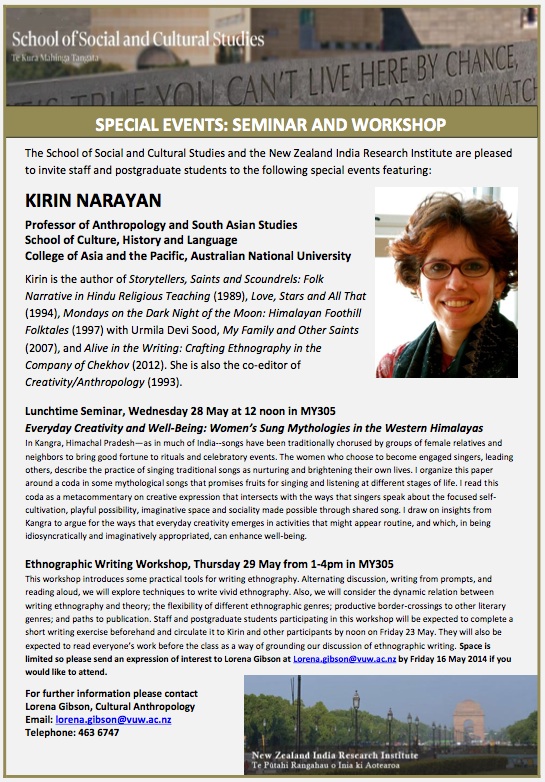
Earlier this year I participated in an online writing group for anthropologists run by Savage Minds. I didn’t achieve all of my writing goals but I did enjoy reading the series of interviews Savage Minds bloggers published with various anthropologists, including one with Kirin Narayan on ethnographic writing. I have long been a fan of Kirin’s work and when I saw that she is now in the School of Culture, History and Language at Australian National University (much closer to New Zealand than the United States) I decided to invite her here to speak about her research. She accepted! Next week she and Ken George will be giving seminars and running workshops/master classes on various aspects of their research at both Massey University in Palmerston North, and Victoria University of Wellington. Details of the Wellington events are below.

KirinNarayan KenGeorge

Write when the baby sleeps

I’ve just started a year-long professional development course for early career researchers* which has given me an opportunity to think about how my writing style has changed since I was working on my PhD. When I was writing my dissertation I had a fantastic writing habit and, inspired by Inger Mewburn’s tips on How to write 1000 words a day without going bat-shit crazy, was producing anywhere between 1000-2000 ‘keeper’ words (that would go directly into the thesis with minimal revision) every day. Things have changed a lot since then: I now have a wonderful, bright, inquisitive, 2-year-old and a job I love. Long gone are the days where I could dedicate all my waking hours to thesis-writing!

The biggest change for me is being a parent. In particular, being the parent of a child who doesn’t like to sleep unless it’s on or next to me. Like Ava Neyer, I read all the baby sleep books in first few months after she was born to try to figure out how to help her sleep. Nothing worked. Eventually we found our own rhythm: I wrote (or read) when the baby slept. Most days I had at least one 25-minute block (or one Pomodoro) where I couldn’t do anything except sit or lie next to my daughter while she slept, so I used this time to write, read, or plan out what I was going to work on next.

She’s getting the hang of sleeping now (we use the Wait It Out method, which works for all of us) but I still use the time just after she’s nodded off to read or think. One of my goals this year is to cultivate a daily writing habit so I can get back into the writing groove I had going as a PhD candidate. To do this, I re-read Charlotte Frost’s top 10 tips for forming good writing habits and joined the Savage Minds Writing Group for anthropologists, which has some fantastic  posts on ethnographic writing. The course I’m on will also help, as will Shut Up and Write sessions (in real life and on #shutupandwrite Tuesdays on Twitter).

I’m keen to hear how other early career academics make space for their writing. Who else does #shutupandwrite Tuesdays on Twitter? How do you juggle parenting with life as an academic?

* Dr Kathryn Sutherland studies the experiences of early career researchers and has recently published her findings: ‘Success in Academia? The experiences of early career academics in New Zealand’