Doing anthropological fieldwork ‘at home’

A month or so ago I posted some thoughts about what it’s really like to be an anthropologist. Not long after that I was asked to talk to a group of Y12 students (high school students in their penultimate year who had come to Victoria University to learn about future study options) about doing anthropological fieldwork. That talk did a much better job of capturing what for me is one of the most rewarding (and challenging) parts of being an anthropologist: doing fieldwork.

I studied Hip-Hop Culture in Aotearoa for my Masters degree in social anthropology, which involved doing fieldwork ‘at home.’ I had long been a fan of Aotearoa Hip-Hop (I used to co-host the Hip-Hop show on Massey University’s student radio station Radio Control) and became interested in understanding how and why Hip-Hop in New Zealand was different to Hip-Hop overseas, particularly the United States. My thesis was based on three years of ethnographic fieldwork (2000-2002) where I explored what Hip-Hop meant to those actively involved in producing and performing Hip-Hop in Aotearoa.

My fieldwork involved a lot of listening and observation. I went to events (b-boy and MC battles, graffiti showcases, gigs, Aotearoa Hip-Hop Summits), used a technique called participant-observation (sometimes known as ‘deep hanging out’ with a purpose) where I would participate in as well as observe what was going on, took fieldnotes and photos, interviewed members of the Hip-Hop community, and tried to immerse myself in all things Hip-Hop.

Lorena doing fieldwork at the 2001 Aotearoa Hip-Hop Summit
Lorena doing fieldwork at the 2001 Aotearoa Hip-Hop Summit in Auckland

People often smile when I tell them my fieldwork involved going to gigs or watching spraycans while people created graffiti art (making jokes like “I bet that was hard work”). However, this kind of fieldwork is not as easy as it sounds. Daniel Simons’ video The Monkey Business Illusion is a great example of how we often miss a lot of what happens around us:
Continue reading
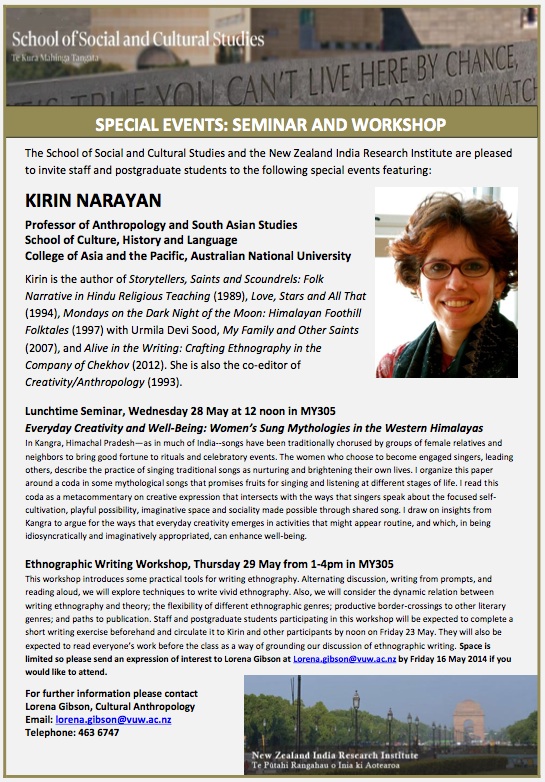
Anthropology workshops at Victoria University of Wellington

Earlier this year I participated in an online writing group for anthropologists run by Savage Minds. I didn’t achieve all of my writing goals but I did enjoy reading the series of interviews Savage Minds bloggers published with various anthropologists, including one with Kirin Narayan on ethnographic writing. I have long been a fan of Kirin’s work and when I saw that she is now in the School of Culture, History and Language at Australian National University (much closer to New Zealand than the United States) I decided to invite her here to speak about her research. She accepted! Next week she and Ken George will be giving seminars and running workshops/master classes on various aspects of their research at both Massey University in Palmerston North, and Victoria University of Wellington. Details of the Wellington events are below.

KirinNarayan KenGeorge

turning your thesis into a book

This is a great post on how to turn your thesis into a book, and very timely for me as it is what I am doing right now. I haven’t taken all of Pat’s advice (I’m working on a full manuscript without a contract, for example) but her tips on rewriting are very useful. Her post has reminded me that I’m writing for a specific genre – ethnography, quite different from a thesis in social anthropology – which has particular conventions that I need to follow, and inspired me to completely rewrite my introduction and conclusion with a new audience in mind. Now, if only I could churn out 2,000 words a day …

pat thomson's avatarpatter

Lots of people want to turn their thesis into a book. This is not always possible – not all theses make good books. But it may also not be desirable. Some disciplines revere the scholarly monograph so writing one may be very good for the career. But others hold the peer reviewed journal article as the gold standard; in such cases, it may be better to get stuck into turning the thesis into a set of papers, rather than sweating over a manuscript. However, if you do want to do the book business, then you have to think about what the common advice – this book is not your thesis – actually means.

The first and most important difference relates to purpose.

The thesis is a text which is written to be examined and evaluated. As such, it follows a particular form, and the writing has to do particular kinds…

View original post 668 more words