
I didn’t know there was a dress code and I read this after I arrived in Chicago. No scarf! Oh well.
Category: Anthropology
The Digital Revolution and Anthropological Film
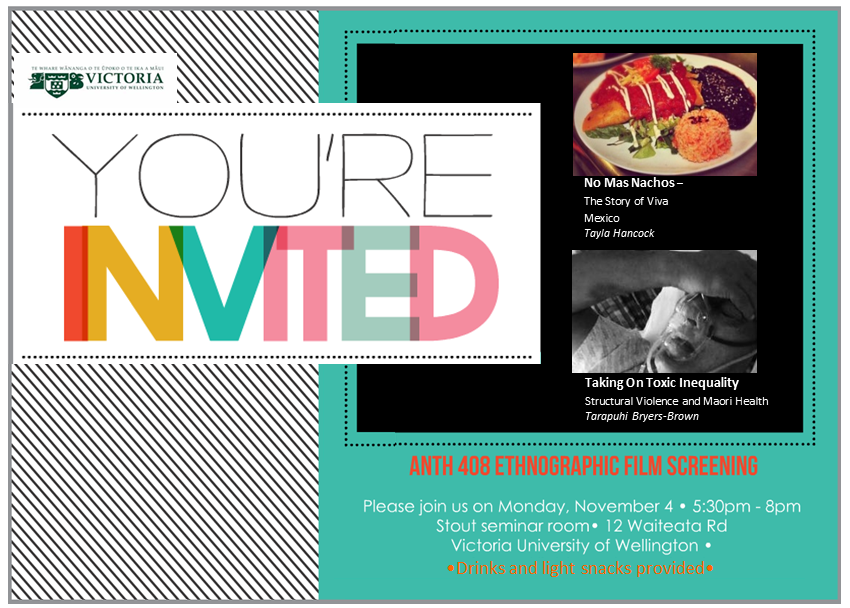
I enjoyed this post by Jay Ruby. I have a somewhat more optimistic view about the future of anthropological cinema though, based in part on the films produced by our 300-level and Honours students in visual anthropology courses taught by Prof. Brigitte Bönisch-Brednich. In fact I’m going to an ethnographic film screening tonight where two of our Honours students are showing films they created as part of their coursework this year. This post has given me lots of food for thought and it will be interesting to discuss various filmmaking techniques with everyone.
If you’re in Wellington, come along!
Venue: Stout Seminar Room, 12 Waiteata Road, Victoria University of Wellington
Time: 5.30-8pm
Making the most of the 2013 American Anthropological Association meeting
UPDATE: Since I posted this, the AAA has released a mobile app for Android and iPhone/iPad users. The AAA Annual Meeting Mobile App replaces the hard copy version of the programme in an effort to help make the event ‘greener’. I will probably give this a go before heading to Chicago later this month.
I’m excited about the 2013 American Anthropological Meeting in Chicago next month. I am presenting a paper as part of the session The Spatial Politics of Enclosure: Creating Persons and Publics.
The session organisers, Barbara Andersen (New York University) and Tate Lefevre (Franklin & Marshall College) of the Melanesia Interest Group, have done a great job in putting together an interesting panel (not just because my paper is in it!) and lining up discussants. Here are my paper details:
Title: Negotiating Space: Hope, development, and a politics of possibility in Kolkata (India) and Lae (Papua New Guinea)
Abstract: Hope is a prominent theme in discourses of development. Through its focus on social change, development provides a way of engaging with a hoped-for future of social justice and equality that is embedded in, but moves beyond, present social, political, and spatial enclosures. In this paper I explore how women living in bastis and settlements in Kolkata (West Bengal, India) and Lae (Morobe Province, Papua New Guinea) negotiate space for themselves, their families, and the wider communities in which they live by participating in grassroots-level development initiatives. I discuss how the various social and spatial arrangements in particular, physical and societal enclosures facilitated by structural inequalities that shape women’s lives in each of these cities simultaneously constrain and provide a basis for their actions. I argue that whether or not they achieve their objectives, such initiatives foster a sense of possibility and movement within and beyond the social and physical spaces these women inhabit.
How to make the most of the meeting?
AAA Meetings are always well-attended with multiple streams of panels running from 8am-9.45pm most days. Based on past experience I know that good planning is essential in order to make the most of my time at the conference. There are a range of new tools available now to help plan everything, including the AAA’s personal meeting scheduler and of course Google Calendar. Kerim has written a useful blog post on Savage Minds combining these two process into one #AAA2013 Google Calendar.
A quick look at the preliminary schedule suggests it’s going to take me a couple of hours to work through everything. The search function of the preliminary schedule seems a bit clunky – for example, looking at the Melanesia Interest Group in the ‘search by section’ function only shows the group’s annual meeting and does not list the session above as we have been sponsored by the American Ethnological Society. Also, because the schedule is only ‘preliminary’ I can’t read many of the abstracts to get an idea of what the papers will be about.
However a couple of sessions run by the Association for Political and Legal Anthropology stand out, this one in particular:
Special Event: Genres of public writing in political and legal anthropology: Addressing Multiple Audiences
Participants: Thomas Hylland Eriksen (,University of Oslo); Ghassan Hage (University of Melbourne); Susan Hirsch (George Mason University); Linda Layne (Rensselaer Polytechnic Institute)
Date: Thursday 21 November 2013
Time: 12.15pm
Venue: Chicago Hilton, conference room 4E
I haven’t started planning my time yet and might end up doing so the old-fashioned way with pen and paper on the longhaul flight from NZ to the USA (although this might not be practical with a 20-month in tow). I am keen to hear from others about conference planning – what tools or apps work well, and which should I avoid? If you are going to the AAA 2013 Meeting, how are you planning your time?
Bloggers and Digital Anthropologists Unite at AAA
I’m going to the AAA in Chicago this year and am keen to meet other blogging and tweeting anthropologists. There are a few of us here in New Zealand and it will be great to meet others from all over the place! I’m not presenting on digital anthropology but will blog and tweet from the conference as I can.
How I use social media in teaching Part II: Wikis on Blackboard
As I mentioned in my first post on using social media in teaching, I use Twitter (and all social media tools) within Victoria University’s Blackboard learning system. This is because students all have access to Blackboard, to campus computers, and to the internet on campus. I don’t expect students to sign up to platforms such as Twitter just for my courses. Also, while many of them do own smartphones, iPads, and laptops, I do not assume that they can all afford (or want) to. Blackboard has a clunky interface and is not the sexist learning environment out there – and student feedback indicates that they don’t particularly like it – but keeping everything ‘in house’ for me is a way of ensuring ease of access.
Tutorial Group Wikis on Blackboard
I teach a large introductory anthropology course and this year adopted a new learning approach to tutorials inspired by Mike Wesch’s World Simulation. I like students to be active participants in tutorials, which I believe should be distinct from lectures in style and content. Rather than summarising set readings or reviewing the lectures, during tutorials each I have each group engage in a collaborative task to help students learn to use the concepts presented and to prepare for their assessed coursework.
I assign each tutorial group to an area on a map of the world and students collectively research and become experts on a real-world cultural group (such as the Trobriand Islanders). Each student chooses a particular aspect of culture to research (e.g., religion or systems of trade and exchange – the list of aspects they choose from aligns with my weekly lecture topics) and works with one or two others to learn all they can about that aspect as it relates to their cultural group. In this way, tutorial groups build a full ethnographic description of the cultures they are assigned. Each student then writes an ethnographic essay based on their aspect of culture which is individually assessed – this is not a form of group assessment.
Wikis are an important part of this collaborative tutorial task for two reasons:
1. Wikis contain a crowdsourced list of relevant references.
This is a research exercise and students are expected to find at least one unique academic resource on their aspect of culture. I encourage them to share relevant resources (by listing the full reference and providing a brief summary of its contents) on their group’s Wiki on Blackboard. When everyone in the tutorial group does this, they build a collective repository of approximately 20 resources they can draw on for their ethnographic essays and other coursework.
2. Wikis become a valuable resource for their coursework.
Part of the essay requires students to discuss how the particular aspect of culture they are focusing on is integrated with the other aspects of their cultural group (e.g., the role of religion in systems of trade and exchange). They do this by participating in tutorials on a weekly basis. The Wiki lets them continue these conversations and work on their essays outside of the classroom setting. When everyone shares their research findings on the Wiki, they collectively build a full ethnographic description of the cultural group they are studying. The Wiki becomes their first ‘go-to’ place when they write their individual essays and prepare for other assignments.
2013 was the first year our class worked with Wikis and I received some wonderfully critical and constructive feedback from students about how to ‘tweak’ the exercise for next year. I am currently processing this feedback and rewriting the collaborative tutorial group instructions for 2014.
Do you (as a student or teacher) work with Wikis on Blackboard? What have your experiences been? What might you do differently (or keep the same) in the future?
AnthroPod: The SCA Podcast
Seems I’m not the only one who likes the name anthropod!* The Society for Cultural Anthropology has recently launched a podcast series dedicated to interviewing cultural anthropologists about their work and experiences in the field.
The two podcasts available so far feature interviews with Michael Fisch (episode 1) about his research on commuter train suicides in Tokyo, and Richard Handler (episode 2) about how he helped to found the graduate Global Development Studies programme at the University of Virginia. Both Fisch and Handler have recently published articles on these topics in the journal Cultural Anthropology, and the podcast links to those articles (one is available through open access, the other is behind a paywall).
I was pleased to discover that the interviews don’t simply repeat what is in the articles; instead they provide the anthropologists with an opportunity to talk about their work in a more informal manner. I enjoyed hearing them enthuse about their work, discuss the challenges of fieldwork, and talk about how they developed their research projects and theoretical frameworks. Prof. Handler’s interview in particular was thought-provoking because of my own research interests in development, and like him I have found a lot of anthropology students are keen to work in the field of development.
The SCA promises more podcasts featuring interviews like this as well as shorter snippets explaining what anthropology is and what anthropologists do. If these first two are anything to go by, I will be a regular subscriber.
* anthropod: a term sometimes used in science fiction to describe humanoid alien beings. (That’s where I came across it, at any rate!)

