The Digital Revolution and Anthropological Film

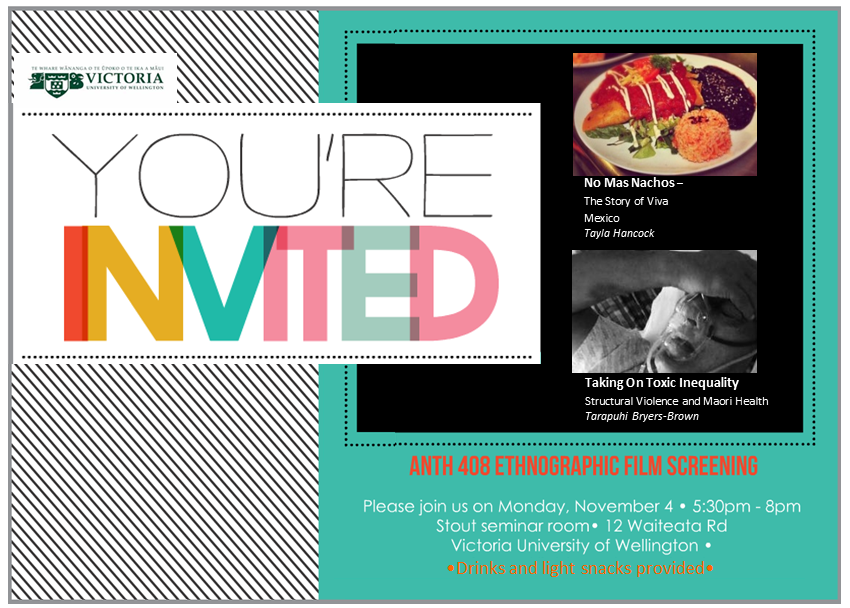
I enjoyed this post by Jay Ruby. I have a somewhat more optimistic view about the future of anthropological cinema though, based in part on the films produced by our 300-level and Honours students in visual anthropology courses taught by Prof. Brigitte Bönisch-Brednich. In fact I’m going to an ethnographic film screening tonight where two of our Honours students are showing films they created as part of their coursework this year. This post has given me lots of food for thought and it will be interesting to discuss various filmmaking techniques with everyone.

If you’re in Wellington, come along!

Venue: Stout Seminar Room, 12 Waiteata Road, Victoria University of Wellington
Time: 5.30-8pm

ANTH408 ethnographic film screening

How I’m participating in Academic Writing Month (#AcWriMo)

Academic Writing Month 2013 starts today and I’m participating this year for the first time. For some reason it passed me by last year, but for the past week my Twitter feed has been filled with people declaring their writing goals and encouraging one another as they gear up for the month-long writing marathon that is #AcWriMo.

The purpose of #AcWriMo is for academics to prioritise writing for the month. One of the things I like about being an academic is that I get (paid) to write a lot. I don’t like the pressure put on academics to publish – what Thesis Whisperer Inger Mewburn calls the academic performance culture – but I love writing and the writing process, so I’m keen to share experiences with others for the month.

#AcWriMo participants are supposed to set and declare goals for the month, make weekly reports (I’ll use Twitter) and declare their results at the end of November. I have 6 goals:

  1. Write and present a paper at the 2013 AAA Meeting in Chicago
  2. Write a review of the film Mr. Pip for Asia Pacific Viewpoint
  3. Attend at least one of the Shut Up and Write sessions organised by my colleagues at Victoria University (#VUWacwri)
  4. Spend two Pomodoros a day, 5 days a week, writing material for publication (I’m part-time at work and have a very active and inquisitive toddler at home so this will be a test for my time management skills!)
  5. Develop the AAA paper into a complete journal article
  6. Start planning the editorial I need to write for a Special Issue of SITES entitled ‘Anthropology and Imagination’

The first two goals will be completed in the next couple of weeks and I will use goals 3 and 4 to help me achieve them. I might not achieve the rest of the goals as I’ll also be marking Honors theses before heading to Chicago then taking 2 weeks’ annual leave after the AAA meeting. I will probably start on goal 5 while I’m on annual leave, as like Anne Galloway I’m keen to try out Inger Mewburn’s strategy for Writing a Journal Article in 7 days. Also, I can never really ‘switch off’ so I’m sure I will achieve a lot of thinking about goal 6 even if I don’t write those thoughts down.

For me participating in #AcWriMo is more about joining an online discussion of academic writing and the writing process than meeting specific goals. I didn’t achieve any of my goals today, for example, but I did spend one Pomodoro doing research for my AAA paper and gave a very short presentation at a seminar on using social media in the classroom at Victoria University (look up #VUWteach on Twitter for live-tweets from the seminar), so I feel like that’s good enough. I will achieve some of my goals and make progress on others and look forward to chatting with others about their progress on Twitter.

Making the most of the 2013 American Anthropological Association meeting

UPDATE: Since I posted this, the AAA has released a mobile app for Android and iPhone/iPad users. The AAA Annual Meeting Mobile App replaces the hard copy version of the programme in an effort to help make the event ‘greener’. I will probably give this a go before heading to Chicago later this month.

I’m excited about the 2013 American Anthropological Meeting in Chicago next month. I am presenting a paper as part of the session The Spatial Politics of Enclosure: Creating Persons and Publics.

The session organisers, Barbara Andersen (New York University) and Tate Lefevre (Franklin & Marshall College) of the Melanesia Interest Group, have done a great job in putting together an interesting panel (not just because my paper is in it!) and lining up discussants. Here are my paper details:

Title: Negotiating Space: Hope, development, and a politics of possibility in Kolkata (India) and Lae (Papua New Guinea)

Abstract: Hope is a prominent theme in discourses of development. Through its focus on social change, development provides a way of engaging with a hoped-for future of social justice and equality that is embedded in, but moves beyond, present social, political, and spatial enclosures. In this paper I explore how women living in bastis and settlements in Kolkata (West Bengal, India) and Lae (Morobe Province, Papua New Guinea) negotiate space for themselves, their families, and the wider communities in which they live by participating in grassroots-level development initiatives. I discuss how the various social and spatial arrangements ­ in particular, physical and societal enclosures facilitated by structural inequalities ­ that shape women’s lives in each of these cities simultaneously constrain and provide a basis for their actions. I argue that whether or not they achieve their objectives, such initiatives foster a sense of possibility and movement within and beyond the social and physical spaces these women inhabit.

How to make the most of the meeting?

AAA Meetings are always well-attended with multiple streams of panels running from 8am-9.45pm most days. Based on past experience I know that good planning is essential in order to make the most of my time at the conference. There are a range of new tools available now to help plan everything, including the AAA’s personal meeting scheduler and of course Google Calendar. Kerim has written a useful blog post on Savage Minds combining these two process into one #AAA2013 Google Calendar.

A quick look at the preliminary schedule suggests it’s going to take me a couple of hours to work through everything. The search function of the preliminary schedule seems a bit clunky – for example, looking at the Melanesia Interest Group in the ‘search by section’ function only shows the group’s annual meeting and does not list the session above as we have been sponsored by the American Ethnological Society. Also, because the schedule is only ‘preliminary’ I can’t read many of the abstracts to get an idea of what the papers will be about.

However a couple of sessions run by the Association for Political and Legal Anthropology stand out, this one in particular:

Special Event: Genres of public writing in political and legal anthropology: Addressing Multiple Audiences
Participants: Thomas Hylland Eriksen (,University of Oslo); Ghassan Hage (University of Melbourne); Susan Hirsch (George Mason University); Linda Layne (Rensselaer Polytechnic Institute)
Date: Thursday 21 November 2013
Time: 12.15pm
Venue: Chicago Hilton, conference room 4E

I haven’t started planning my time yet and might end up doing so the old-fashioned way with pen and paper on the longhaul flight from NZ to the USA (although this might not be practical with a 20-month in tow). I am keen to hear from others about conference planning – what tools or apps work well, and which should I avoid? If you are going to the AAA 2013 Meeting, how are you planning your time?

turning your thesis into a book

This is a great post on how to turn your thesis into a book, and very timely for me as it is what I am doing right now. I haven’t taken all of Pat’s advice (I’m working on a full manuscript without a contract, for example) but her tips on rewriting are very useful. Her post has reminded me that I’m writing for a specific genre – ethnography, quite different from a thesis in social anthropology – which has particular conventions that I need to follow, and inspired me to completely rewrite my introduction and conclusion with a new audience in mind. Now, if only I could churn out 2,000 words a day …

pat thomson's avatarpatter

Lots of people want to turn their thesis into a book. This is not always possible – not all theses make good books. But it may also not be desirable. Some disciplines revere the scholarly monograph so writing one may be very good for the career. But others hold the peer reviewed journal article as the gold standard; in such cases, it may be better to get stuck into turning the thesis into a set of papers, rather than sweating over a manuscript. However, if you do want to do the book business, then you have to think about what the common advice – this book is not your thesis – actually means.

The first and most important difference relates to purpose.

The thesis is a text which is written to be examined and evaluated. As such, it follows a particular form, and the writing has to do particular kinds…

View original post 668 more words

How I use social media in teaching III: In the classroom

In this final post in a series on how I use social media in teaching I focus on what I do in the classroom. I’ll begin with a summary of my learning and teaching philosophy, which I include in course outlines:

This course combines lectures and films with interactive tutorials in a format designed to guide students through the major topic areas and encourage discussion. The emphasis is on collaborative learning through dialogue and active participation rather than passively listening to lectures. Lectures will utilise various forms of technology (Blackboard, Twitter) in order to encourage in-class participation so students are welcome to bring smartphones, iPads, netbooks or laptops to class.

In future this will be followed with a caveat based on recent research carried out by Faria Sana, Tina Weston and Nicholas Cepeda (2013) which found that in-class use of laptops hinders classroom learning for both users and nearby peers. I will still encourage people to bring technologies to class but recommend that they read this article and try to stay off Facebook and other distractions during class (unless I have specifically asked them to look at something online).

Like most lecturers, I usually show a relevant YouTube clip or a TED talk (TED-Ed is a great tool for the classroom) during class, which I embed within Blackboard so students can view them again in their own time. I also add extra relevant links (YouTube, blogs, websites) to Blackboard for those students who are really keen on the subject and want to find out more. I do not expect students to watch anything extra that I have not shown in class, but I do want to inspire them to check out interesting anthropological content when they are browsing the web in their own time.

In large classes (300+ students) I use a ‘virtual lecture hall tool’ on Blackboard. This is what I have called the Course Blog function within Blackboard (although I am sure I could probably come up with a better title for it!). It is a way for students to ask a question without having to raise their hands and speak up in front of everyone, which can be daunting for some. Students can post questions here during lectures and I set aside time to look at the questions – usually when I am showing a YouTube clip or TED talk – and respond to them either straight away or at the beginning of the next lecture.

When I respond I just address the question; I don’t look for the person who asked it. To start with I tried to engage with students by naming and looking for the authors of questions (students cannot post anonymously to Blackboard) but found that doing so discouraged some from using the tool – they wanted to remain as anonymous as possible. I only answer questions in class and do not post replies or monitor the ‘virtual lecture hall tool’ outside of the lecture situation.

I use other social media (such as Facebook) as objects of study. Facebook is a great topic with which to explore anthropological concepts and one which resonates with students. However I do not use Facebook as a vehicle to communicate with students. I have found that students usually create their own group Facebook pages for courses, which I do not participate in or view. I think it is good for students to have a space to ask one another questions and discuss course content that is not monitored by lecturers or tutors – kind of like a virtual library corner.

I would be interested to hear from others  – teachers and students – about experiences with social media in teaching. I’m sure I could learn a lot from your practices!

How I use social media in teaching Part II: Wikis on Blackboard

As I mentioned in my first post on using social media in teaching, I use Twitter (and all social media tools) within Victoria University’s Blackboard learning system. This is because students all have access to Blackboard, to campus computers, and to the internet on campus. I don’t expect students to sign up to platforms such as Twitter just for my courses. Also, while many of them do own smartphones, iPads, and laptops, I do not assume that they can all afford (or want) to. Blackboard has a clunky interface and is not the sexist learning environment out there – and student feedback indicates that they don’t particularly like it – but keeping everything ‘in house’ for me is a way of ensuring ease of access.

Tutorial Group Wikis on Blackboard

I teach a large introductory anthropology course and this year adopted a new learning approach to tutorials inspired by Mike Wesch’s World Simulation. I like students to be active participants in tutorials, which I believe should be distinct from lectures in style and content. Rather than summarising set readings or reviewing the lectures, during tutorials each I have each group engage in a collaborative task to help students learn to use the concepts presented and to prepare for their assessed coursework.

I assign each tutorial group to an area on a map of the world and students collectively research and become experts on a real-world cultural group (such as the Trobriand Islanders). Each student chooses a particular aspect of culture to research (e.g., religion or systems of trade and exchange – the list of aspects they choose from aligns with my weekly lecture topics) and works with one or two others to learn all they can about that aspect as it relates to their cultural group. In this way, tutorial groups build a full ethnographic description of the cultures they are assigned. Each student then writes an ethnographic essay based on their aspect of culture which is individually assessed – this is not a form of group assessment.

Wikis are an important part of this collaborative tutorial task for two reasons:

1. Wikis contain a crowdsourced list of relevant references.
This is a research exercise and students are expected to find at least one unique academic resource on their aspect of culture. I encourage them to share relevant resources (by listing the full reference and providing a brief summary of its contents) on their group’s Wiki on Blackboard. When everyone in the tutorial group does this, they build a collective repository of approximately 20 resources they can draw on for their ethnographic essays and other coursework.

2. Wikis become a valuable resource for their coursework.
Part of the essay requires students to discuss how the particular aspect of culture they are focusing on is integrated with the other aspects of their cultural group (e.g., the role of religion in systems of trade and exchange). They do this by participating in tutorials on a weekly basis. The Wiki lets them continue these conversations and work on their essays outside of the classroom setting. When everyone shares their research findings on the Wiki, they collectively build a full ethnographic description of the cultural group they are studying. The Wiki becomes their first ‘go-to’ place when they write their individual essays and prepare for other assignments.

2013 was the first year our class worked with Wikis and I received some wonderfully critical and constructive feedback from students about how to ‘tweak’ the exercise for next year. I am currently processing this feedback and rewriting the collaborative tutorial group instructions for 2014.

Do you (as a student or teacher) work with Wikis on Blackboard? What have your experiences been? What might you do differently (or keep the same) in the future?

How I use social media in teaching Part I: Twitter

In an earlier post I discussed why I use social media in teaching: as a pedagogical tool, and for my own professional development. In this post (the first in a series on how I use social media in teaching) I focus on how I use Twitter.

Until recently, I have not had much luck in using Twitter as a teaching tool within the classroom. In 2011 I experimented with Twitter as a backchannel for students in a small 300-level (third year) anthropology class. I set up a class account, which I used, and embedded the Twitter stream in Blackboard for everyone to see. I tweeted during lectures to show them the difference between thick and thin tweets (as David Silver describes it) and encouraged them to set up their own Twitter accounts. I designed in-class activities that involved composing 140-character questions and tweeting them to the authors of the films and articles we were watching and reading at the time. (The authors were all anthropologists I followed on Twitter, and I checked with them beforehand to make sure they were happy to receive and respond to student tweets.) I also monitored the class account and class hashtag during and outside lectures so I could respond to any student queries or comments.

Despite my efforts, it did not take off. The students just weren’t into it. As one student put it, they felt that Twitter was for “old people” like me.

Today I still embed my Twitter stream in Blackboard (using my own account rather than a class account) but I don’t encourage students to set up their own accounts or tweet questions to me during class. Instead, I talk about Twitter during lectures and draw their attention to my Twitter stream to model how I use this form of social media as an anthropologist. Most of the time they are astonished to find that I follow hundreds of anthropologists on Twitter and that we tweet about things other than what we had for lunch.

I have had more success with Twitter at Honours level. As I mentioned in a recent post, students live-tweeted from our recent Anthropology and Agency Honours Student Conference. They seemed to enjoy the experience and the interested generated within the wider academic community about their research (which they are keen to collate into a journal and make publicly available later this year).

For me, Twitter is most useful as a way to find out about current research, to engage in conversations about teaching practice, and to source new lecture material. In future I might try using Twitter to “co-construct” lecture content (an approach described by Daniela Retelny, Jeremy Birnholtz and Jeffrey Hancock), but based on my past experiences I think this would be best suited to a smaller, 300-level or above class.

There is quite a bit of information available on teaching with Twitter (e.g., Teaching with Twitter by Stephanie Hedge on Inside Higher Ed, and this guide on Web 2.0/3.0 Teaching from Dartmouth College Library). I am keen to hear how others – especially students – use Twitter in a university setting. What has worked for you? What hasn’t worked?

Changing India: From Decolonization to Globalization Conference 2013

I am looking forward to the inaugural conference of the New Zealand India Research Institute, which starts tomorrow. The conference theme is Changing India: From Decolonization to Globalization and it will critically examine the changes that have taken place since Independence.

I am just putting the finishing touches on the following paper, which I plan to develop into a journal article:

Bastis as “forgotten places” in Howrah, West Bengal, India

Abstract:
Kolkata’s poverty is world-famous. Howrah, located on the opposite side of the Hoogly river and Kolkata’s twin city, fares worse. Howrah’s bastis (slums) have been described as “deplorable”, “dirty”, “filthy” and “overcrowded” since the late 1800s. India’s recent rapid economic growth has not improved the lives of those living in poverty – many of whom are Muslim – in Howrah’s bastis. This paper argues that Howrah’s bastis are “forgotten places”, historically and politically constructed habitats that are neglected, but nevertheless deeply inhabited, by the state (Lee & Yeoh, 2006: Fernandes, 2010). In these bastis, services that are the responsibility of the state – such as access to civic amenities – are not adequately provided for. It discusses how such “forgotten places” leave a gap that NGOs and grassroots organisations try to fill, and draws on ethnographic fieldwork to describe the efforts of Howrah Pilot Project, an organisation that runs grassroots-level development initiatives in one of Howrah’s bastis. Such organisations can be viewed as a response to processes of ‘active forgetting’ but need to be augmented by a responsive state in order to achieve meaningful, long-term, beneficial change.

Check out the rest of the NZIRI 2013 Conference Programme to see what else people will be talking about.

AnthroPod: The SCA Podcast

Seems I’m not the only one who likes the name anthropod!* The Society for Cultural Anthropology has recently launched a podcast series dedicated to interviewing cultural anthropologists about their work and experiences in the field.

The two podcasts available so far feature interviews with Michael Fisch (episode 1) about his research on commuter train suicides in Tokyo, and Richard Handler (episode 2) about how he helped to found the graduate Global Development Studies programme at the University of Virginia. Both Fisch and Handler have recently published articles on these topics in the journal Cultural Anthropology, and the podcast links to those articles (one is available through open access, the other is behind a paywall).

I was pleased to discover that the interviews don’t simply repeat what is in the articles; instead they provide the anthropologists with an opportunity to talk about their work in a more informal manner. I enjoyed hearing them enthuse about their work, discuss the challenges of fieldwork, and talk about how they developed their research projects and theoretical frameworks. Prof. Handler’s interview in particular was thought-provoking because of my own research interests in development, and like him I have found a lot of anthropology students are keen to work in the field of development.

The SCA promises more podcasts featuring interviews like this as well as shorter snippets explaining what anthropology is and what anthropologists do. If these first two are anything to go by, I will be a regular subscriber.

* anthropod: a term sometimes used in science fiction to describe humanoid alien beings. (That’s where I came across it, at any rate!)